
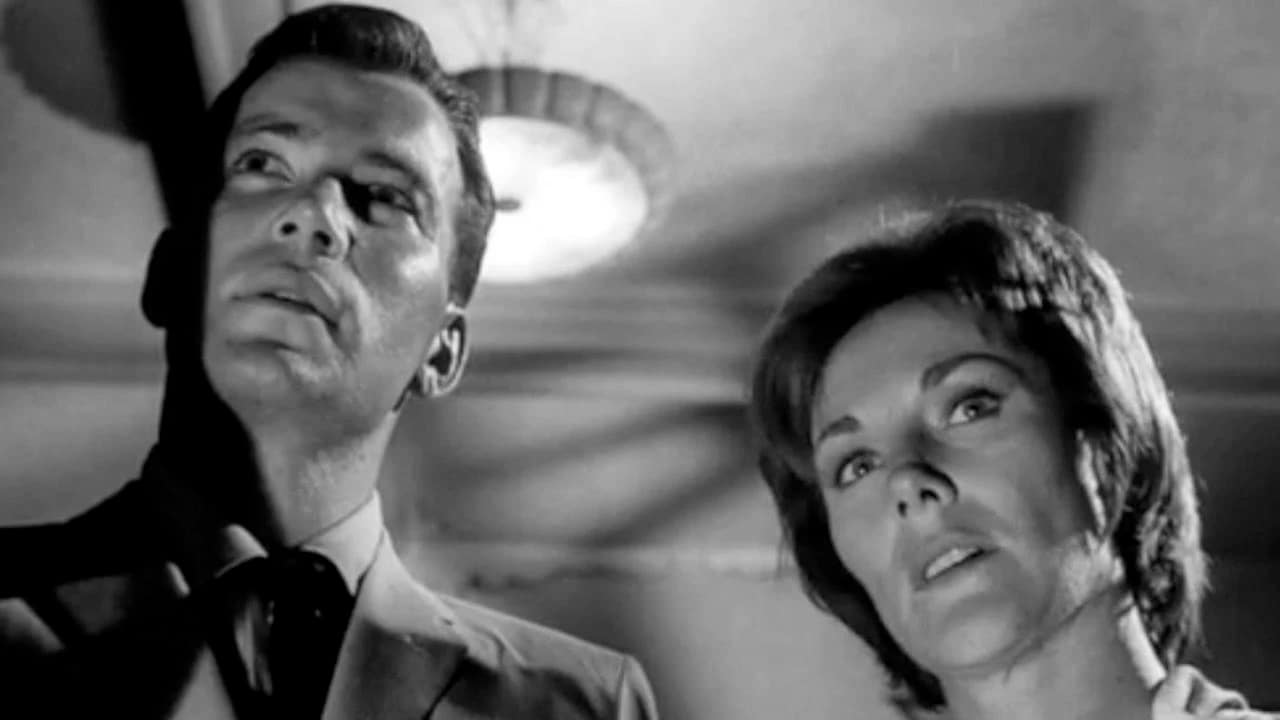

Dir: Roger Corman | US Thriller 1962
The Intruder: Roger Corman’s incendiary portrait of American prejudice
There is a particular audacity to Roger Corman’s The Intruder, a film made in 1962 that seems, more than six decades later, to have lost none of its capacity to unsettle. Long regarded as something of an outlier in the prolific director’s career, this fiercely independent, politically engaged drama is arguably one of his most important achievements: a film that strips away the familiar pleasures of genre cinema to confront the poisonous mechanics of racism, mob mentality and the seductive power of demagoguery.
Set in a small Southern town on the eve of school desegregation, the film follows Adam Cramer, played with chilling conviction by William Shatner, a charismatic outsider who arrives ostensibly to defend the community’s traditions but whose real purpose is to inflame racial hostility. With his polished manners, persuasive rhetoric and carefully cultivated air of moral authority, Cramer is a professional agitator, exploiting the fears and resentments of white residents to mobilise resistance against the admission of Black students into the local high school. What begins as political manipulation gradually becomes something far more sinister, as rhetoric translates into intimidation, violence and the collective abandonment of reason.
Corman’s achievement lies in his refusal to treat racism as the aberration of a handful of grotesque individuals. Instead, he examines how prejudice is manufactured, organised and legitimised, and how easily apparently respectable citizens can become complicit in something profoundly ugly. The film’s most disturbing moments are not necessarily its eruptions of violence but the scenes in which ordinary people, persuaded that their way of life is under threat, surrender their judgement to a persuasive stranger.
Shatner, still some years away from his defining television role in Star Trek, gives one of the most nuanced performances of his early career. His Cramer is not a crude, snarling villain but an accomplished manipulator, whose charm is precisely what makes him dangerous. He understands the psychology of his audience, knows when to flatter and when to provoke, and turns the language of community, morality and freedom into instruments of exclusion. It is a performance that gives the film much of its unsettling contemporary resonance.
Visually, Corman works with the economy and urgency that characterised his best independent productions. The documentary-like immediacy of the small-town locations, the restless movement of the camera and the often uncomfortable proximity to the characters lend the film an almost journalistic texture. There is little ornamental distance between the audience and the unfolding ugliness. Corman wants us to feel trapped within this increasingly febrile atmosphere, observing the speed with which a community can be radicalised.
LONDON’s BFI SOUTHBANK with introduction by Julie Corman on 13 November 2026