
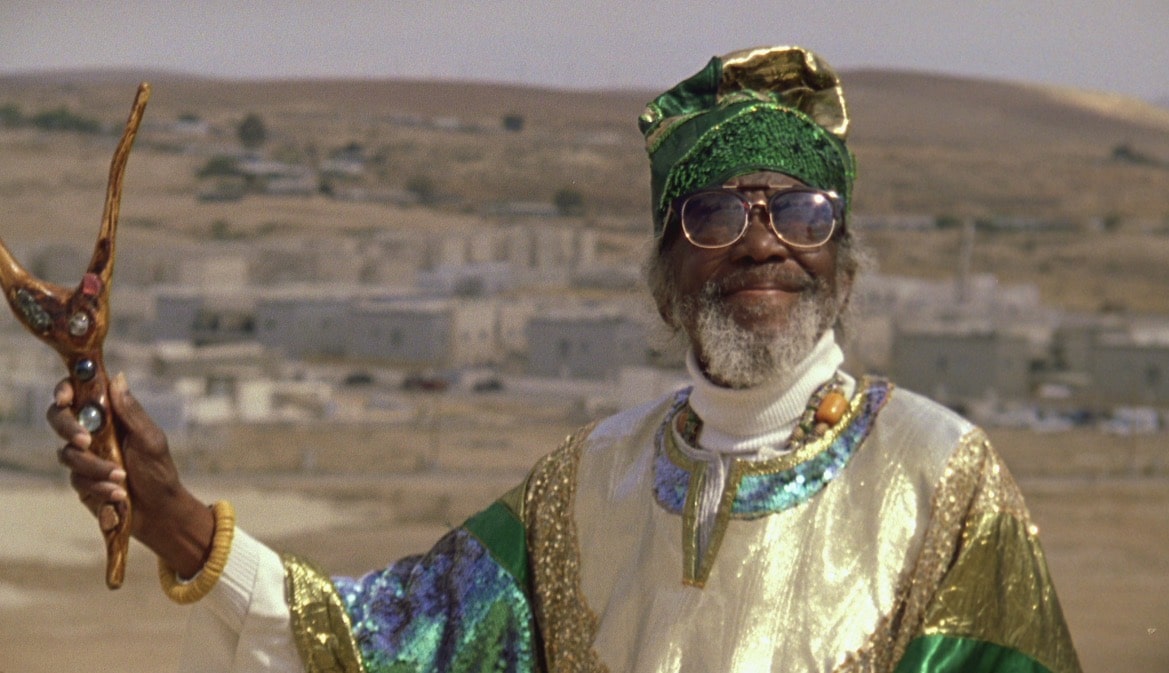


Dir: Emilija Škarnulytė | Doc 71’
Sounds of the Desert: a journey into Sun Ra’s cosmic imagination
Jazz has rarely travelled quite so far from its earthly origins as in the universe inhabited by the Sun Ra Arkestra. Part musical collective, part philosophical experiment and part Afrofuturist voyage into the unknown, this remarkable ensemble provides the inspiration for Lithuanian filmmaker Emilija Škarnulytė’s Sounds of the Desert. Following the international success of Burial (2022), Škarnulytė embarks on an altogether different kind of expedition, exploring the enduring legacy of a musician who believed his creative home was somewhere beyond Saturn.
At the centre of the film is the extraordinary figure of Sun Ra, the jazz composer, bandleader and self-proclaimed visitor from another planet whose music challenged virtually every convention of the genre. Born Herman Poole Blount in Birmingham, Alabama, in 1914, he emerged from Chicago’s jazz scene in the 1950s with an entirely new musical and philosophical vocabulary. Combining free jazz, big-band arrangements, electronic experimentation, Egyptian mythology and science fiction, he created a universe in which music became a means of imagining freedom beyond the limitations of earthly existence. His was an audacious vision, rooted in the experience of Black America yet reaching towards the cosmos, where history, mythology and the future could be reimagined.
Though Sun Ra died in 1993, his extraordinary musical legacy remains very much alive through the Arkestra, now led by the remarkable Marshall Allen. One of the film’s most fascinating presences, Allen is a living testament to the durability of this vision. His saxophone playing, at once adventurous, searching and exuberantly expressive, carries the spirit of an ensemble that has spent decades refusing to stand still. Alongside him is Abshalom Ben Shlomo, another longstanding member of the Arkestra, whose presence reinforces the sense of a musical fraternity bound together by shared experience, discipline and an almost mystical devotion to their art.
The musicians are not simply custodians of an established repertoire. They are participants in an ongoing act of creation. Their performances move between tightly orchestrated passages, explosive brass improvisations, hypnotic percussion and moments of collective abandon. There is something ritualistic about the way they play, as though each performance is an attempt to summon a world that exists just beyond the reach of ordinary perception. Their elaborate costumes and theatrical gestures are not merely decorative eccentricities but extensions of Sun Ra’s philosophy: a refusal to accept the identities and boundaries imposed by the familiar world. The Arkestra’s music is simultaneously celebratory and confrontational, playful and profound, capable of moving from joyous exuberance to almost meditative contemplation.
Škarnulytė takes this remarkable musical inheritance on a journey from Chicago to the Negev Desert, where the landscape becomes more than a picturesque backdrop. Its expanses of sand, rock and open sky offer a visual counterpart to the Arkestra’s boundless sonic imagination. There is an almost lunar quality to the terrain, a sense of remoteness that makes it seem perfectly suited to musicians whose artistic ambitions have always extended beyond the terrestrial. The desert becomes a place of encounter between different temporalities: the ancient and the futuristic, the geological and the human, the remembered and the imagined.
The filmmaker weaves together live performances, archival footage and encounters with Allen and Ben Shlomo, allowing the past to converse with the present. The archival material provides glimpses of Sun Ra’s extraordinary artistic world, while the contemporary sequences reveal how that world continues to evolve through the musicians who carry it forward. Rather than treating the Arkestra as a historical curiosity, Škarnulytė approaches it as a living organism, sustained by the energy and imagination of its members. The film’s most interesting proposition is perhaps that artistic legacy is not something preserved behind glass but something continually reinvented through performance.
There is also a deeper political and cultural dimension to this journey. Sun Ra’s Afrofuturism was never simply an eccentric fascination with outer space. It offered an imaginative escape from a history shaped by slavery, racial oppression and the systematic denial of Black autonomy. By inventing an alternative cosmology, Sun Ra challenged the authority of conventional historical narratives and proposed another way of understanding identity, belonging and liberation. His cosmic mythology was both an act of resistance and an assertion of possibility. In this sense, the Arkestra’s music carries a significance that extends well beyond its extraordinary musical vocabulary.
Škarnulytė’s approach is appropriately contemplative. She is less concerned with constructing a conventional biographical documentary than with finding a visual language capable of responding to the music’s unusual rhythms and philosophical reach. The film moves between performance, landscape and archival memory, allowing images to breathe rather than insisting upon a continuous explanatory narrative. This freedom is one of its attractions, although it also creates a certain distance. Viewers unfamiliar with Sun Ra’s history and the Arkestra’s extraordinary evolution may find themselves wanting a little more context about the musicians, their individual journeys and the remarkable circumstances through which this collective came into being. The film’s atmospheric approach occasionally comes at the expense of a fuller exploration of the personalities behind the music.
Nevertheless, there is something affecting about witnessing these musicians continue to inhabit a vision conceived so many decades ago. Marshall Allen, in particular, embodies the paradox at the heart of the film: the passage of time is written into his physical presence, yet his music seems to resist the very idea of mortality. What survives is not simply a repertoire or a style but a way of looking at the world, an insistence that imagination can be a form of emancipation.
Ultimately, Sounds of the Desert is an invitation to listen differently and to look beyond the apparent limits of the familiar. Sun Ra imagined another planet as a place of freedom; his Arkestra continues to travel towards it, carrying with them the sounds, histories and dreams of generations. Škarnulytė captures the strange beauty of this continuing voyage, even if her film occasionally leaves us longing to know more about the extraordinary people making the journey. Its most lasting impression is of music as a form of transcendence: a means of escaping the gravity of history without ever forgetting where one has come from.
A film that finds, in the vast silence of the desert, the continuing reverberations of a truly singular musical universe.