
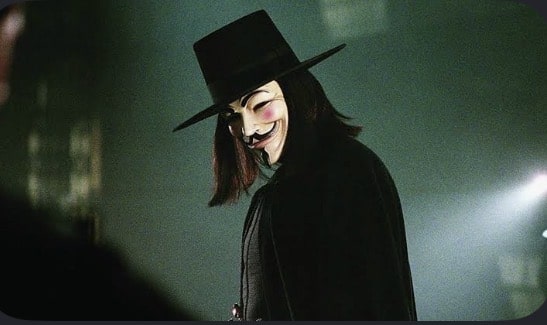

V for Vendetta – the revolution still wears a mask
James McTeigue | Cast: Hugo Weaving, Natalie Portman, Stephen Rea, Stephen Fry John Hurt | UK Political thriller
There are films that capture the political anxieties of their moment, and others that seem to acquire an altogether sharper edge with the passing of time. James McTeigue’s V for Vendetta belongs firmly in the latter category.
Released in 2005, this adaptation of Alan Moore and David Lloyd’s celebrated graphic novel has matured into something rather more unsettling than a stylish dystopian thriller: a cautionary tale about the fragility of democracy, the seductions of authoritarianism and the extraordinary power of fear to make people surrender their freedoms.
Set in a bleak, near-future Britain governed by the totalitarian Norsefire regime, the film introduces us to a society where dissent is crushed, the media is manipulated, minorities are persecuted and citizens are kept obedient through surveillance and manufactured terror. Into this atmosphere of state-sanctioned oppression comes V (Hugo Weaving), a mysterious, masked revolutionary who wages a spectacular campaign against the government, seeking to awaken a population that has become accustomed to its own subjugation.
His unlikely accomplice is Evey Hammond (Natalie Portman), a young woman rescued from the secret police whose gradual political and personal awakening provides the film with its emotional centre. As V’s campaign gathers momentum, the distinction between liberation and vengeance becomes increasingly complicated.
McTeigue, making his directorial debut after working as an assistant director on The Matrix films, brings an unmistakable visual confidence to the material. The influence of the Wachowskis, who wrote the screenplay, is apparent in the film’s elaborate action choreography, graphic-novel compositions and stylised urban landscapes. London becomes a landscape of oppressive architecture, anonymous government buildings and shadowy streets, while V’s theatrical interventions lend the proceedings an almost operatic quality.
The performances are central to its success. Weaving, whose face remains concealed throughout, delivers a remarkably expressive performance through voice, rhythm and physical presence. His V is at once eloquent, seductive, menacing and faintly absurd: a man who quotes Shakespeare, adores classical music and treats political assassination as a piece of theatrical choreography. It is an unusual piece of screen acting, and arguably the film’s greatest achievement.
Portman gives Evey a convincing vulnerability, although her character’s transformation occasionally feels more schematic than psychologically convincing. Stephen Rea brings welcome intelligence and restraint to Inspector Finch, the investigator gradually uncovering the terrible machinery behind the regime. Stephen Fry provides an affecting glimpse of the private courage that can survive beneath public conformity, while John Hurt is chilling as Adam Sutler, the self-appointed guardian of a nation supposedly under siege. There is an unmistakable Orwellian joke in casting Hurt, who played Winston Smith in the 1984 film, as another incarnation of Big Brother.
The film’s greatest strength, however, is its understanding of how authoritarianism operates. It does not simply depend upon armed force. It manufactures enemies, controls information, exploits public anxiety and turns insecurity into political currency. The parallels with contemporary concerns about mass surveillance, propaganda, disinformation, political extremism and the persecution of minorities are difficult to ignore.
There are shortcomings. The Wachowskis’ screenplay simplifies some of the more anarchistic and philosophically complex ideas of Alan Moore and David Lloyd’s original graphic novel, replacing aspects of its radical politics with a more conventional Hollywood narrative of individual resistance and collective liberation. Moore himself disowned the adaptation, although his objections also concerned the way his work was handled and credited. V’s own methods raise uncomfortable questions which the film never entirely resolves: can violence committed in the name of freedom ever be distinguished from the violence of the oppressor? And who gets to decide when revolution becomes justified?
The spectacular destruction of Parliament and Big Ben is visually impressive, but the film is at its most powerful when it abandons pyrotechnics for the quieter business of moral awakening. Its final movement, in which ordinary citizens emerge wearing identical Guy Fawkes masks, remains an extraordinarily potent cinematic image.
Has it stood the test of time? Initially, the film received a mixed critical response, with some reviewers questioning its political simplifications and its treatment of terrorism. Roger Ebert, however, recognised that there was considerably more going on beneath its comic-book exterior than in the average effects-driven blockbuster.
Its subsequent cultural life has been remarkable. The Guy Fawkes mask escaped the cinema to become an internationally recognisable symbol of protest, most notably through the Anonymous movement and Occupy demonstrations. The film has also attracted serious academic attention for its treatment of surveillance, political manipulation and the relationship between technology and state power.
Indeed, its twentieth anniversary in 2026 has brought renewed attention to its political prescience, with McTeigue himself reflecting on how many of the anxieties explored in the film have become familiar features of contemporary political life.
Perhaps the most interesting aspect of revisiting V for Vendetta today is that its dystopia no longer feels quite so comfortably distant. Its warnings about governments exploiting fear, the manipulation of public information and the erosion of civil liberties have lost none of their force. Yet the film is not simply a manifesto for rebellion. It is also a plea for individual conscience, intellectual freedom and the refusal to accept that political power is beyond challenge.
Verdict: Not quite the philosophical firecracker of Moore’s original graphic novel, and occasionally too enamoured of its own revolutionary spectacle, but a remarkably durable piece of political cinema. Weaving is magnificent, the imagery lingers long after the credits and its central questions have become, if anything, more pressing.
Remember, remember the fifth of November. Twenty years on, V for Vendetta still has something worth saying — and perhaps rather more urgently than its makers originally imagined.
A note on its anniversary: The film’s original US release was in March 2006, although it is frequently associated with 2005 because of its production and earlier release history. Its twentieth-anniversary celebrations are taking place in 2026.
IN SELECT CINEMAS from 6 NOVEMBER 2026