
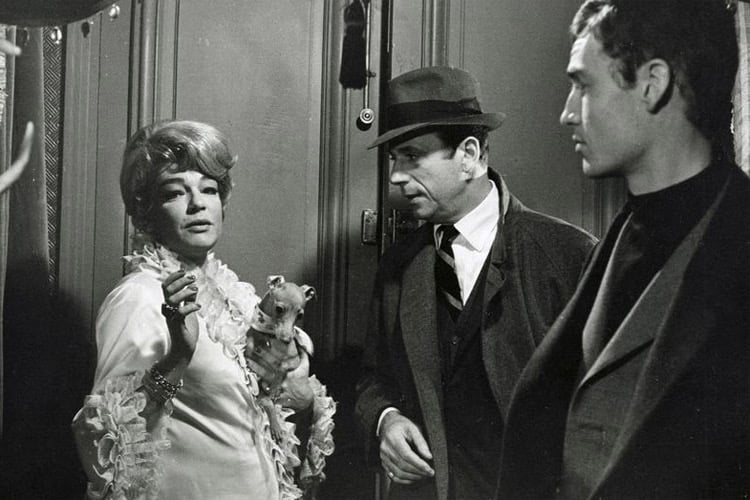

Dir: Costa-Gavras | France thriller 1965
Few films make such exhilarating use of a train as The Sleeping Car Murders (Compartiment tueurs). A brilliantly constructed murder mystery, it combines the claustrophobic pleasures of the classic railway thriller with a distinctly French appetite for eccentric characterisation, social observation and psychological intrigue.
Costa-Gavras announced himself as a formidable director of thrillers with this 1965 feature debut, a deliciously ingenious murder mystery claustrophobically set in a railway couchette. Adapted from Sébastien Japrisot’s novel, it is a film in which a routine overnight journey from Marseille to Paris turns into a nightmare of strangulation, suspicion and mounting fatalities. When a young woman, Bambi (Catherine Allégret), wakes to discover that one of her fellow passengers has been murdered, the arrival of Inspector Grazzi (Yves Montand) sets in motion an increasingly complicated investigation. But the mystery deepens when the other occupants of the sleeping compartment begin dying too, leaving the police struggling to establish not only who the killer is but what connects these seemingly unrelated travellers.
The train is an inspired setting for this kind of exercise in suspense. Its narrow corridors, curtained compartments and fleeting encounters create an atmosphere of confinement and paranoia, while the relentless forward motion of the journey gives the film an almost physical momentum. Costa-Gavras exploits every opportunity for visual mischief, moving between intimate close-ups, prowling camera movements and briskly edited sequences that keep the audience guessing. Shot in atmospheric black and white, the film has the unmistakable flavour of French film noir, although its dark subject matter is constantly undercut by a deliciously wry sense of humour. The subsequent police investigation, with its crowded offices, competing theories and bureaucratic distractions, provides an entertaining counterpoint to the increasingly sinister events.
The cast is certainly starry. Yves Montand makes an engagingly human detective, combining professional determination with an exasperation that becomes increasingly comic as the bodies accumulate. Simone Signoret brings her customary intelligence, authority and ambiguity to her role, while her daughter Catherine Allégret provides a younger, more vulnerable presence. Michel Piccoli is particularly effective, lending his character that familiar, elusive quality which makes it difficult to decide quite where his loyalties lie. Jean-Louis Trintignant and Jacques Perrin further enrich an ensemble that seems almost extravagantly well supplied with talent. There is real pleasure in watching these actors share the screen, even when their characters are doing little more than concealing information or looking suspicious.
What distinguishes The Sleeping Car Murders from a conventional whodunit is its remarkable balance of suspense, character comedy and narrative ingenuity. Costa-Gavras understands the importance of pacing, allowing clues and revelations to emerge with just enough teasing deliberation before accelerating towards the increasingly tangled conclusion.
There are echoes of Hitchcock in the manipulation of audience expectations, but the film has its own distinctly French personality, more playful and socially observant than a straightforward exercise in suspense. It also offers an early indication of the director’s command of intricate plotting and his fascination with institutions and the machinery of investigation, qualities that would become much more pronounced in Z.
Nearly sixty years on, the film remains an enormously enjoyable piece of popular cinema: stylish, witty, wonderfully performed and sufficiently ingenious to keep even seasoned crime enthusiasts guessing. Above all, it demonstrates that a train, a handful of strangers and a very large body count can provide all the ingredients for a first-class thriller.
NOW ON ARTE.com