


Dir: Alex Cox | US Western 88’ 2025
Alex Cox rides into the sunset with a decidedly crooked take on the American West in Dead Souls, a mischievous, politically charged Western that finds the veteran British provocateur returning to familiar territory: corruption, exploitation, institutional absurdity and the uneasy relationship between history and power. Reportedly his final film, it is an appropriately anarchic farewell from a director who has never been particularly interested in playing by Hollywood’s rules.
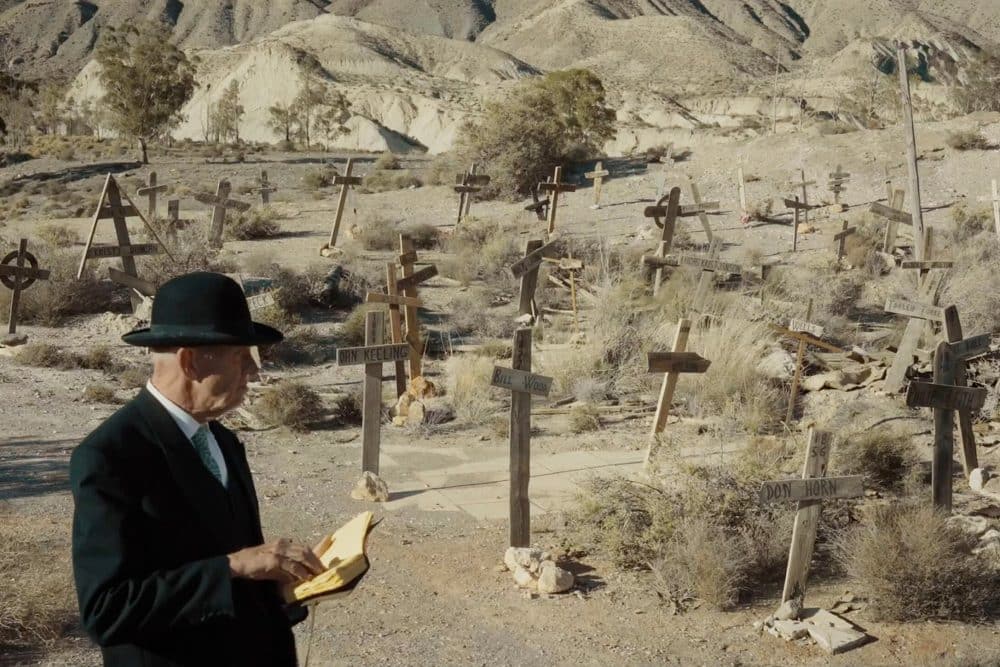
Set in Arizona in 1890, the film follows the mysterious Strindler (Cox), a dapper, black-bowler-hatted stranger who arrives in a dusty frontier town with an unusual business proposition. He is prepared to pay landowners, ranchers and local businessmen for the names and dates of death of Mexican labourers who have died in their employment or on their property. His motives remain tantalisingly obscure. Is he a government official, a census collector, a representative of the Mexican authorities or something altogether more sinister? As he moves between saloons, ranches and the town’s assorted power brokers, his increasingly elaborate explanations expose a community whose inhabitants are perfectly willing to put a price on the dead while conveniently distancing themselves from responsibility for their deaths.
The premise is drawn from Nikolai Gogol’s 1842 novel Dead Souls, in which a travelling confidence trickster buys the names of deceased serfs whose deaths have not yet been registered. Cox relocates Gogol’s satire on Russian bureaucracy and social pretension to the American frontier, where the currency is Mexican labour, the exploitation of migrant workers and the mythology of the American Dream. It is a neat, if hardly subtle, transposition.
The contemporary resonance is unmistakable. Strindler’s peculiar census-taking exercise evokes the machinery of immigration control and the political obsession with identifying, categorising and excluding outsiders. In Cox’s hands, the dead become a commodity, their identities available for purchase and their exploitation conveniently erased by the passage of time. The film’s most provocative suggestion is that the American frontier was built not simply on ambition and enterprise, but on the systematic disposability of those whose labour made other people’s fortunes.
Visually and tonally, this is a love letter to the spaghetti Western, with Cox drawing on the dusty landscapes of Almería, Spain, where so many European Westerns were made, as well as the iconography of Sergio Corbucci and Sergio Leone. There are crooked sheriffs, dubious officials, gun-toting hotheads and the inevitable threat of a showdown. But this is no conventional exercise in genre nostalgia. Cox is more interested in puncturing the Western’s heroic mythology than in recreating its grand operatic confrontations.
The film’s deliberately theatrical performances, episodic construction and shoestring aesthetic give it the air of a frontier vaudeville. Its tonal excursions include a musical interlude featuring the living and the dead, stop-motion animation and moments of surreal comedy that threaten to derail the narrative altogether. Yet these eccentricities are integral to Cox’s method. He has always preferred the disruptive gesture to the polished convention, and Dead Souls is no exception.
As Strindler, Cox gives himself a suitably peculiar leading role: part travelling salesman, part bureaucratic phantom, part philosophical observer. His performance is understated to the point of inscrutability, while Zander Schloss provides a useful counterpoint as the town’s knowing, disreputable guide. The supporting characters are deliberately broad, embodying the venality and self-interest of a society in which everyone has something to sell and nobody wants to answer for the past.
There are echoes of Cox’s earlier Walker (1987), his audacious assault on American imperialism in Nicaragua, as well as the anarchic sensibility of Straight to Hell. The difference is that Dead Souls feels less like an angry young filmmaker’s provocation than the work of an older director taking stock of a world whose absurdities have become increasingly difficult to satirise.
The result is uneven, occasionally baggy and sometimes more pleased with its own eccentricity than with narrative momentum. But there is an unmistakable intelligence behind its apparent ramshackle construction. Cox is not simply making a Western; he is interrogating the stories America tells itself about its origins, its wealth and its right to decide whose lives count.
Not a conventional crowd-pleaser, nor an especially polished swansong, but a distinctly individual piece of filmmaking. Those expecting the kinetic energy of Repo Man or the emotional intensity of Sid and Nancy may find its pace and theatricality something of a surprise. For audiences prepared to embrace its oddball humour and political irreverence, however, Dead Souls is a worthwhile, frequently entertaining reminder of what independent cinema can still get away with. Cox may be riding off into the sunset, but he is certainly not going quietly.
IN UK CINEMAS 6 NOVEMBER 2026