

Dir: Rafael Manuel | Drama | Philippines, Singapore, UK, France, Netherlands, 2026, 100’ / Filipino, Ilokano
Reviewed by Peter Herbert
Filipinana is entirely set in one day, as teen girl Isabel (Joyybell Agoto) arrives on a bus to work in an upmarket health resort golf course in Manila. It is soon apparent that this is not an offshoot of Mike White’s White Lotus but debut feature-length director Rafael Manuel has created a unique piece of cinema. Beneath a carefully designed elaborate surface Manuel reflects upon the Philippines with Filipinana describing artefacts of cultural, historic, political memory and relevance.
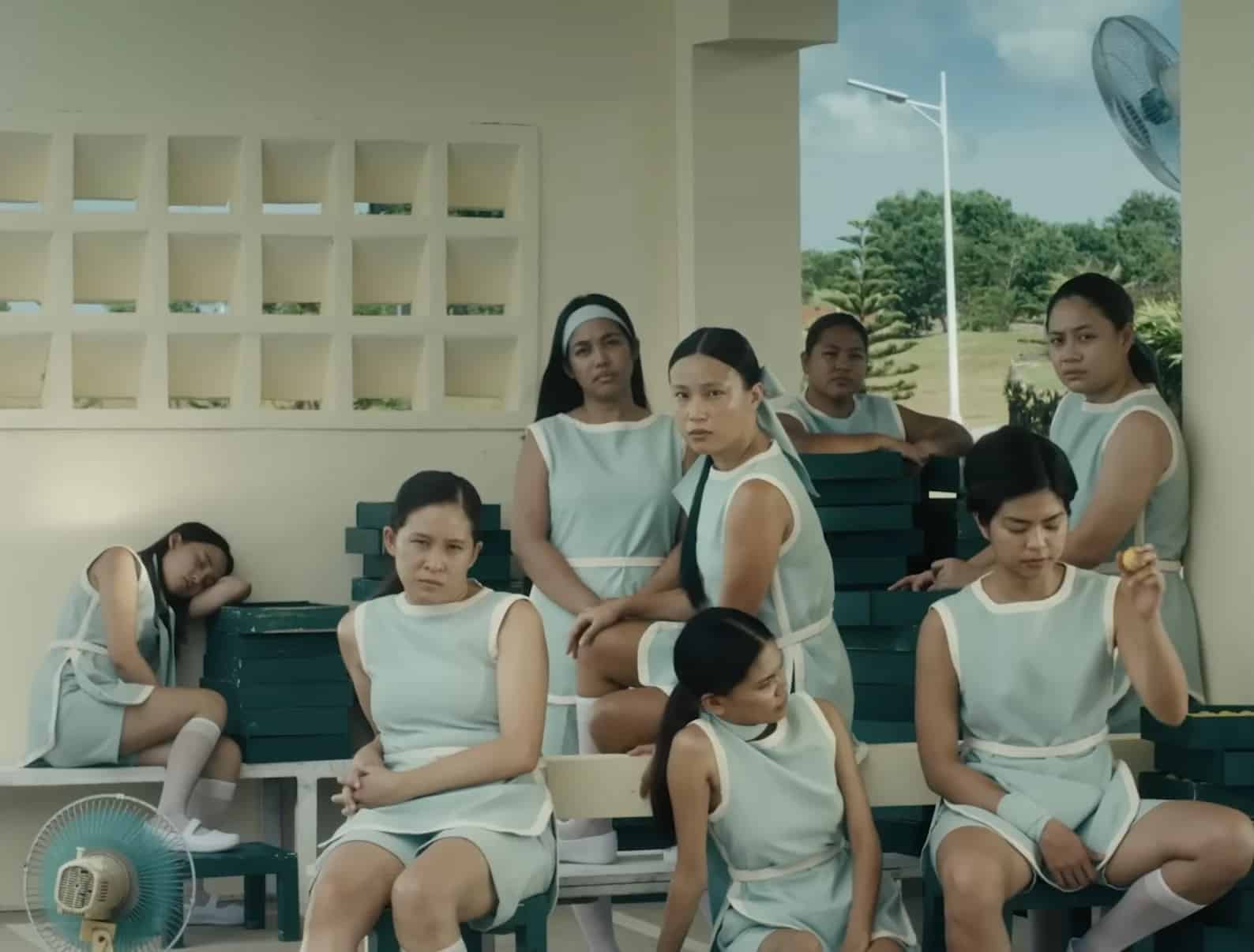
Isabel is observed navigating the course of the day which is mundane as she looks for ways to return a golf club to the authoritarian director Dr Palenko of the health resort golf course. Her labyrinthine journey reveals a world of men treating women like players as if an elaborate chess board with moves designed to conquer and defeat. The tee doll caddy girls are subservient as if there is a coded in-built understanding that there is only one way to behave which is to deliver without disturbing. Filipinana develops a wide overall canvas but there are also details in minutiae as her doll-like behaviour reveals tremors, and over 100 minutes the careful pattern of the film begins to crack.
Details in the film’s construction are compelling. A tiny lick of cream, or eating a strawberry left by a guest is a sneaky act that might result in dismissal. A senior woman seen napping in front of a television screen suggests the power of hierarchy between the women. Rotting fruit sits among others that are ripe. A room of tabletops being cleared and remade by a circle of girls feels like mimed choreography of a dance routine. A new tree arrives, driven on a truck like a trophy, to replace a dying tree, so as not to disturb symmetry of the garden lawns. The search for a golf ball reveals an unseen body that will be removed as if nothing has happened, and an ancient stone Buddha is stranded in the pristine contours of the golf course.
A gathering of women in flowing gowns walk through a hallway followed by more women and then a couple more. As each group moves up a spiral staircase they all converge together to take a selfie together. This is a satirical touch suggestive of Frank Tashlin’s 1950s American satires of modern life.
Rows of girls wearing the same pastel-coloured uniform are viewed sitting between the parted legs of men, monotonously placing golf balls, so the men don’t have to bend while playing golf. At one point the girls talk about the colours of men’s balls which may be the funniest scene in any film seen so far this year.
All these details are embedded into a bold structure that has not been seen since Jacques Tati’s Playtime (1967) created Paris as a re-constructed reality revealing how technology, furniture and architecture can depersonalise humanity. On the other side of Tati are the deeply detailed chiaroscuro interiors of Wes Anderson.
Manuel is somewhere between both filmmakers with a similar eye, while using a real location. The political eye is comparable to Lav Diaz and Lucrecia Martel although the critique to be found in Filipinana is not explicit didacticism and more subtle as to how the viewer is involved and implicated.
The film deserves to be seen on a big screen to fully appreciate intricate visual designs. It is a tour de force built entirely from the simple placement of a static Academy ratio camera. Rhythms emerge through intercutting between a series of single shots involving alternating close-up, medium and long shot viewpoints, creating patterns of kinetic beauty. This resembles overall a huge patchwork quilt with the hypnotic pace of images involving clouds, buildings and rows of trees looking as if an experimental James Benning film viewed through a kaleidoscope. The effect is exhilarating without obscuring narrative and thematic themes.
Filipinana was developed into feature-length by Manuel from a short film made in 2022 with the director guided and clearly mentored by the Chinese filmmaker Jia Zhangke of Still Life and A Touch of Sin.
The final sequence includes an ending designed to catch the attention span of the viewer off guard. Viewers who stay on past the false ending are rewarded with beautifully crafted credit titles of such design perfection as to recall Saul Bass. Filipinana offers far more for patient viewing than a casual glance suggests.
UK RELEASE 20 NOVEMBER 2026 | Bfi London Film Fedtival UK première