

Dir: Claude Chabrol | France, Thrilller 1970
Claude Chabrol was the most cheerfully poisonous of the French New Wave directors. While Godard was busy dismantling cinema and Truffaut was making tenderness look like an existential condition, Chabrol settled down to investigate the bourgeoisie, that great French institution devoted to keeping up appearances while something ghastly festers beneath the wallpaper. He was the movement’s great anatomist of respectable people behaving badly, preferably over a good meal and with the curtains drawn.
An early critic of bourgeois hypocrisy, Chabrol became its most entertaining undertaker. His films are full of provincial notables, respectable marriages, respectable businesses and respectable people who, one suspects, would cheerfully murder the neighbours if it could be done without upsetting Sunday lunch. In films such as Les Biches, La Femme infidèle and Le Boucher, he made the apparently ordinary positively sinister. His great gift was to understand that evil rarely announces itself with a fanfare. More often, it asks you to pass the salt.
Then there is the matter of knives. Chabrol had, by all accounts, a particular fascination with them, a predilection recalled by his wife and frequent leading lady, as here, Stéphane Audran. Whether you consider Le Boucher as a domestic eccentricity or a detail best kept in mind when accepting an invitation to dinner, it seems entirely appropriate that one of his finest films should revolve around a butcher. Chabrol, who understood the symbolic possibilities of a dinner table better than most directors understood the possibilities of a camera, knew that a knife could be both a perfectly ordinary kitchen implement and a rather alarming extension of the human personality.
In Le Boucher, the knife is never merely a knife. It is a tool of the trade, a fact of rural life, a quiet threat and, ultimately, a way of expressing feelings for which the characters have no adequate vocabulary. It is also a splendidly economical cinematic device. No expensive special effects are required when a man has a sharp blade, a troubled mind and an entire village prepared to mind its own business.
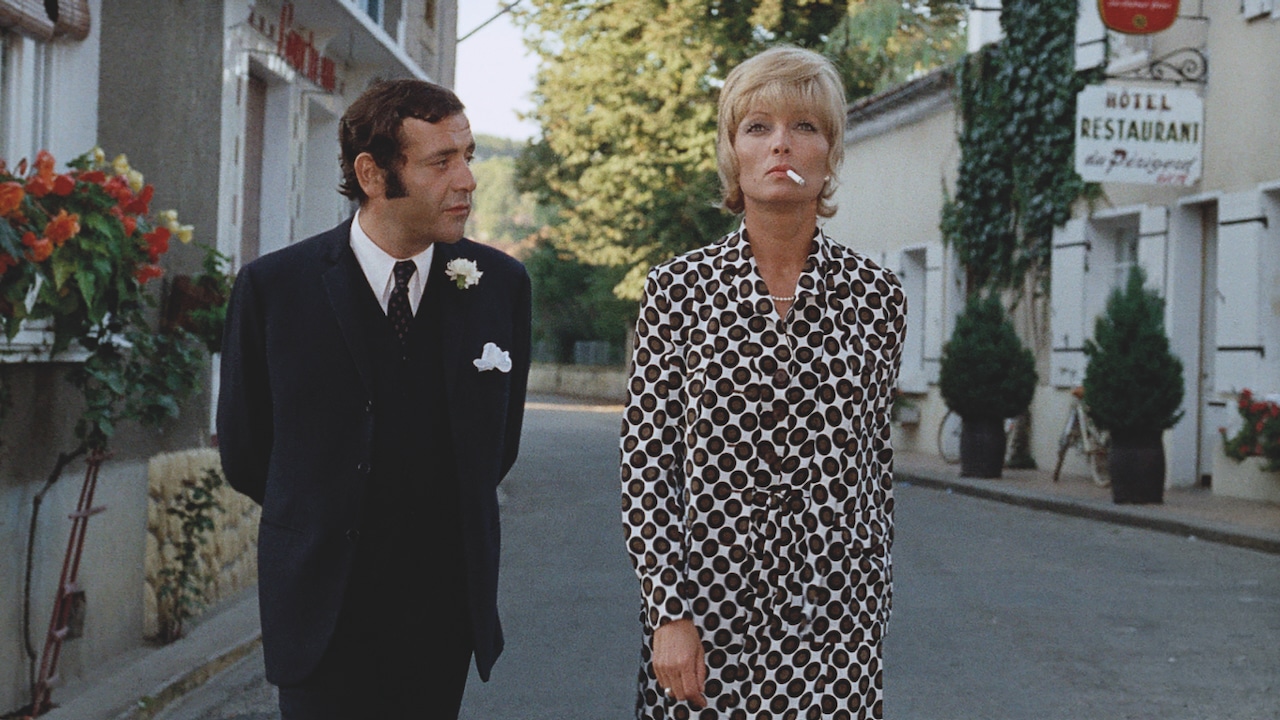
Set in the Dordogne, this chilling two-hander brings together Hélène, played by the mannered, often coquettish, Stéphane Audran, a schoolteacher whose composure suggests that she has long ago made peace with disappointment, and Popaul, played by Jean Yanne, the local butcher. The two meet at a wedding, where the French countryside exudes carnal pleasure: food, wine, easy conversation, dancing and the general impression that civilisation consists of knowing everybody else’s business while pretending not to.
Hélène and Popaul strike up a friendship. She is intelligent, reserved and emotionally inaccessible; he is warm, decent, lonely and carrying the psychological baggage of a life that has been less than kind to him. He has served in wars and seen things no one should see, and his attempts at ordinary happiness have been frustrated by the usual human complications. He can slaughter an animal with professional efficiency but is rather less equipped to handle the delicate business of the heart.
Hélène, meanwhile, has her own history of romantic disappointment. She is not a woman who has stopped feeling so much as one who has learnt to keep feeling under strict supervision. Her classroom is orderly, her manner composed, her private life a closed book. One suspects that if happiness were to knock on her door, she would first ask it to make an appointment.
Chabrol places these two people together with the patience of a man arranging pieces on a chessboard, although his interest is less in checkmate than in the strange, hesitant movements people make towards one another when they are frightened of being known. Then the murders begin.
Young women are found brutally killed, and the bucolic idyll acquires an unpleasant new dimension. The countryside, which had seemed so reassuringly timeless, becomes a landscape of suspicion. The local community carries on, naturally. Villages have a remarkable capacity for accommodating horror, provided it does not interfere too much with the market, the school timetable or the arrangements for the next wedding.
The genius of Le Boucher is that it refuses to become a conventional whodunit. Chabrol is not especially interested in making us play detective, ticking off suspects and congratulating ourselves on having spotted the murderer before the final reel. Instead, he gives us something far more disquieting: the knowledge that we may understand a person without being able to save them, and that sympathy is not the same thing as innocence.
The film’s tension comes from the terrible discrepancy between what we know, what we suspect and what Hélène is prepared to acknowledge. Audran’s performance is a masterclass in restraint. Her face can convey a whole emotional history without appearing to have done anything at all. She listens, observes and occasionally smiles, and one feels that an entire novel has just passed behind her eyes while the other person was still struggling to finish a sentence.
Jean Yanne is equally extraordinary. Popaul is not presented as a monster imported from some lurid Gothic imagination. He is a recognisable man, capable of kindness, humour and genuine tenderness. His loneliness is not theatrical; it is the sort that has settled into the bones. He wants companionship, and he wants to be understood. Unfortunately, the universe has supplied him with a butcher’s knife and a set of emotional circumstances that make the search for intimacy rather more complicated than it ought to be. This is where the film becomes unexpectedly modern.
For all its reputation as a classic French psychological thriller, Le Boucher is also a devastating study of loneliness and lost love. Its central tragedy is not simply that violence exists, but that two people can stand so close to one another and remain separated by an almost unbridgeable distance. They share meals, conversations and stretches of the same countryside, yet there is a fundamental loneliness in each that the other cannot quite penetrate.
Popaul reaches towards Hélène with the awkward sincerity of someone who has not entirely given up on human connection. Hélène, who has already experienced the disappointment of love, is caught between compassion and fear. She recognises his vulnerability, perhaps even something of her own in it, but recognition does not magically produce the courage to love. Nor does it provide a reliable instruction manual for dealing with a man who may be responsible for a series of murders. One can hardly blame her for wanting to take things slowly.
Chabrol’s brilliance lies in refusing to turn this emotional predicament into a neat moral lesson. He is too intelligent to suggest that loneliness automatically makes people dangerous, or that love can cure every wound. His characters inhabit the untidy territory between pity and desire, fear and tenderness, where most human relationships actually take place. The horror comes from the possibility that the need to be loved can coexist with something monstrous, and that the person we feel sorry for may also be the person we should fear.
Visually, the film is deceptively simple. Chabrol makes extraordinary use of the Dordogne’s pale stone buildings, quiet roads, green countryside and ordinary domestic interiors. The landscape is beautiful without being sentimental. There is no need for a haunted castle when a village school, a butcher’s shop and a roadside picnic will do perfectly well. The camera watches rather than announces, allowing unease to accumulate almost imperceptibly. A conversation that begins with cake and polite remarks can leave one feeling as though the furniture has shifted a few inches while nobody was looking. And then there is the cake.
Food in Chabrol is rarely innocent, although it is usually appetising. Eating is a social ritual, a display of good manners, an expression of affection and occasionally a reminder that the civilised world rests on rather fragile foundations. In Le Boucher, meals become occasions for connection, but also for the uneasy recognition that we are never entirely sure what lies beneath another person’s good manners. The cake is perfectly ordinary. It is the company that makes it troubling.
The film’s cult reputation is therefore not difficult to understand. It offers the pleasures of a murder thriller without the mechanical satisfactions of a puzzle; the beauty of French provincial life without the comforting delusion that beauty makes people good; and two extraordinary central performances that make its moral complications feel painfully intimate. It is suspenseful, yes, but it is also funny in that dry, slightly cruel Chabrolian fashion, where the absurdity of everyday behaviour becomes more disturbing than any amount of thunder and lightning.
Above all, it understands that the past is never quite past. War, disappointment, rejection and unspoken grief travel with people into the present, where they are expected to behave normally, attend weddings, eat cake and make polite conversation. Most manage it. Some do not. Chabrol is interested in the thin, uncertain line between the two.
More than half a century after its release, Le Boucher feels less like a period piece than a film that has quietly caught up with us. Its concerns are entirely contemporary: emotional isolation, the failure of intimacy, the difficulty of recognising another person’s suffering and the terrible consequences of leaving certain feelings unspoken for too long. We live in an age of constant communication and unprecedented opportunities to make contact, yet the essential predicament remains unchanged. People are lonely. They want to be seen. They want to be loved. And sometimes, when they cannot find the words, they do something appalling instead.
Chabrol, being Chabrol, offers no comforting resolution to this problem. He leaves us with the uneasy sense that human beings are capable of tenderness and cruelty in the same breath, and that the most frightening things may occur not in the darkness beyond the village, but among people we have known for years.
Le Boucher is a film about murder, certainly, but its real subject is the terrible distance between wanting to love someone and knowing how to do it. The knife is memorable; the blood is shocking; the suspense is immaculate. Yet what lingers is something quieter and sadder: the spectacle of two lonely people who briefly find one another, only to discover that sympathy cannot always bridge the gulf between them.
A superb thriller, then, and a rather bleak advertisement for the perils of emotional repression. If you happen to be invited to a wedding in the Dordogne, by all means go. Enjoy the wine, admire the countryside, have some cake. Just be careful whom you confide in, and perhaps leave the knives to the professionals. Chabrol, one suspects, would have approved of that last precaution. He might even have asked you to stay for dinner.
NOW ON BFI PLAYER and the Chiswick Cinemas London W6