
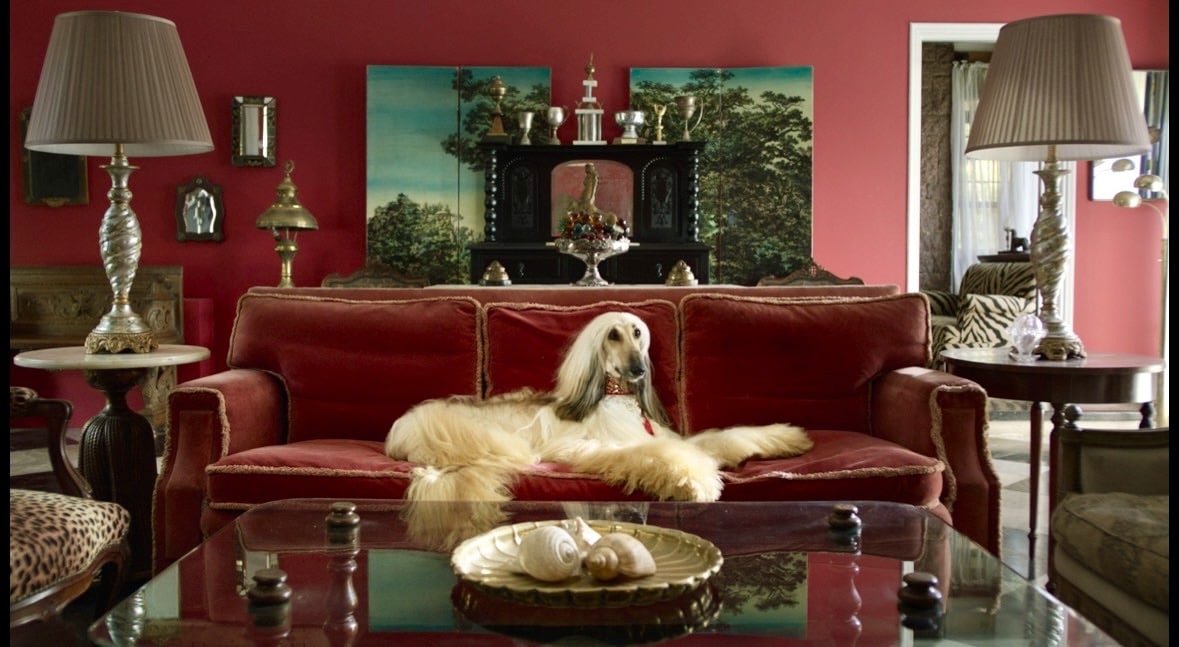

Dir: Federico Borgia | Comedy Drama 94’
There are worse things to inherit than a luxury seaside villa. An Afghan hound, for instance, might seem an unlikely beneficiary — until you meet the humans waiting patiently for him to die.
Prince, unveiled in world premiere at the London Film Festival, is a deliciously oddball black comedy in which canine custody becomes a full-blown class war. When wealthy Isabel dies, her beloved, prize-winning Afghan hound Prince inherits her property, while her relatives are left circling like vultures around a particularly glamorous dog basket. Jaime, Isabel’s long-serving butler and former lover, is appointed Prince’s guardian, setting up a battle in which inheritance law, family resentment and outright greed collide.
The joke, naturally, is that Prince is the only character who has absolutely no interest in the property. He just wants to be a dog.
Borgia gives the material a suitably extravagant visual treatment. The fading glamour of Punta del Este becomes a character in itself: sumptuous interiors, swimming-pool blues, empty spaces and slightly decadent seaside architecture creating a world that looks as though Visconti wandered into a particularly dysfunctional episode of Succession. The compositions are precise without becoming precious, and the film’s visual style keeps finding sly ways to make its characters look ridiculous against their surroundings.
There is something wonderfully artificial about the whole affair — appropriately so. Borgia turns the villa into a kind of gilded pressure cooker, where every room seems to contain another grievance, secret or prospective act of treachery. The pool, in particular, acquires an almost operatic importance. Nobody should be allowed to have quite this much trouble beside such attractive water.
Roberto Suárez gives Jaime a beautifully rumpled mixture of loyalty, wounded pride and desperation, while Maitina De Marco’s Isabel remains an enjoyably poisonous presence even after her departure. Esteban Bigliardi adds another layer of familial antagonism. But the real star is, inevitably, Prince himself: magnificently indifferent to the human melodrama taking place in his name.
What makes the film convincing is that beneath its absurdity Borgia understands the uglier seriousness of its subject. Prince is really about ownership — of property, status, affection and even other people. The dog simply exposes how quickly supposedly civilised behaviour disappears when there is a house worth fighting over.
It is also very funny, but not in the conventional gag-machine sense. Borgia prefers deadpan absurdity, visual jokes and the escalating spectacle of otherwise respectable adults behaving appallingly. The comedy gradually acquires a sinister edge, and the film’s stylish surfaces begin to feel rather more dangerous than decorative.
A distinctive, visually assured and agreeably peculiar debut, Prince has the rare quality of making you wonder whether you are watching a family drama, a social satire, a canine thriller or an unusually elegant hostage situation. The answer, happily, is all four.
And Prince? He deserves every square metre of the villa.
Bfi LONDON FILM FESTIVAL 2026