
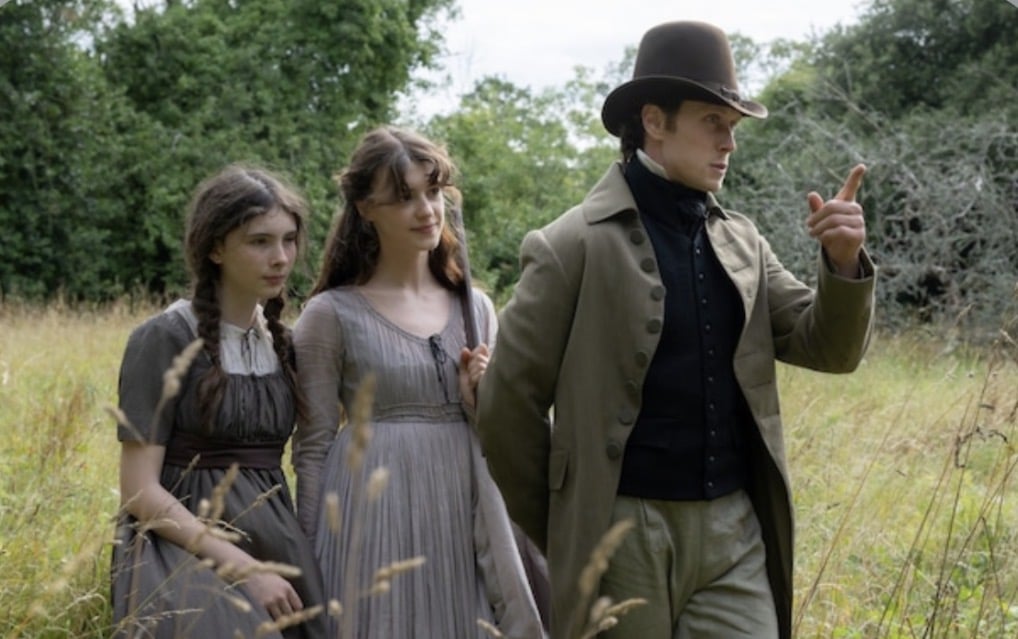

Dir: Georgia Oakley | Drama 2026 132’
Sense and Sensibility — An Also-Ran Austen
Jane Austen’s Sense and Sensibility has been filmed several times, but the new version directed by Georgia Oakley arrives under the considerable shadow of Ang Lee’s 1995 film, scripted by Emma Thompson.
There have also been the BBC adaptations of 1971, 1981 and 2008, each taking a different approach to Austen’s story. The 1995 film remains the benchmark: Thompson and Kate Winslet made Elinor and Marianne vivid opposites, while Hugh Grant and, particularly, Alan Rickman gave the male characters a depth and romantic weight that this new film struggles to match.
Oakley’s version is not without interest, but it ultimately feels like an also-ran — a handsome, earnest reworking that never quite justifies its existence. At more than two hours, it is also simply too long for a film that has so little fresh to say about Austen’s familiar tale.
The central story remains compelling: a family of women suddenly deprived of their financial security, forced from their comfortable home and obliged to negotiate a society in which marriage is not merely romantic fulfilment but economic survival. The Dashwood sisters’ disappointments and frustrations acquire a particular poignancy when seen against the male-dominated world of Austen’s time, where women possessed few independent means of controlling their own destinies.
The film is at its strongest when it explores that social reality. The contrast between the Dashwoods’ comparatively restricted existence and the seductive power of London is especially effective. London is presented not simply as a glamorous destination but as the centre of the social machinery through which marriages, money and status are arranged. For a poor country girl hoping to make a good marriage, it is where the important matches are made — and where social opportunity is concentrated. These scenes give the film a sharper sense of what Austen was actually observing beneath the romantic plot.
There are also moments when the emotional predicament of the sisters comes through with real force. Their disappointment, dependence and struggle to retain dignity in a society structured around male privilege are more interesting than the film’s attempts to make the romance feel contemporary.
Daisy Edgar-Jones is easily the film’s strongest asset. Her Elinor has intelligence, restraint and an appealing emotional seriousness, while George MacKay brings genuine warmth and vulnerability to Edward Ferrars. Fiona Shaw, meanwhile, gives the film a welcome injection of personality as Mrs Jennings, making the most of a character who can otherwise easily become a comic Austen caricature.
Elsewhere, however, the performances are largely bland and unremarkable. Most damagingly, Herbert Nordrum’s Colonel Brandon makes remarkably little impression. After Alan Rickman’s memorably romantic and melancholy interpretation in 1995, Brandon needs to register as a man whose emotional history and devotion give Marianne a reason to reconsider her romantic ideals. Here he seems almost incidental — visually and dramatically insignificant.
That points to the larger problem. Oakley and screenwriter Diana Reid clearly want to find something contemporary in Austen, but the film never quite discovers a new perspective powerful enough to replace what earlier adaptations already achieved. Its more naturalistic, earthy approach is sometimes attractive, yet it can also make the characters feel strangely ordinary.
There is nothing disastrously wrong with this Sense and Sensibility. It is respectful, competently made and occasionally perceptive. But Austen’s novel deserves more than competence. The best adaptations illuminate something in the original that we had not quite seen before. This one largely illustrates it again.
The strongest material is therefore not the romance itself but the social landscape surrounding it: London as the marketplace of marriage, the economic vulnerability of women, and the Dashwood sisters’ struggle to find emotional and practical independence in a society that gives them very little room to manoeuvre. Those elements remind us why Austen’s story remains so durable.
Unfortunately, once the film has made those points, there is rather a lot of it left. At over two hours, the pacing becomes increasingly ponderous, and the film’s lack of distinctive dramatic energy becomes difficult to ignore. Edgar-Jones, MacKay and Shaw provide the necessary sparks, but they are not enough to transform this into a memorable new Austen adaptation.
It is, in the end, Sense and Sensibility without quite enough sense of its own.
NOW In cinemas