

Dir: Avelina Prat | Drama 2025
Avelina Prat’s charmingly old-fashioned film about getting lost, starting again — and borrowing someone else’s life
There is something rather lovely about The Portuguese House. In an age when films often seem obliged to shout, explain and keep us permanently entertained, Avelina Prat has made something almost unfashionably gentle: a perceptive film about loneliness, friendship, deception. It is also, refreshingly, in no particular hurry.
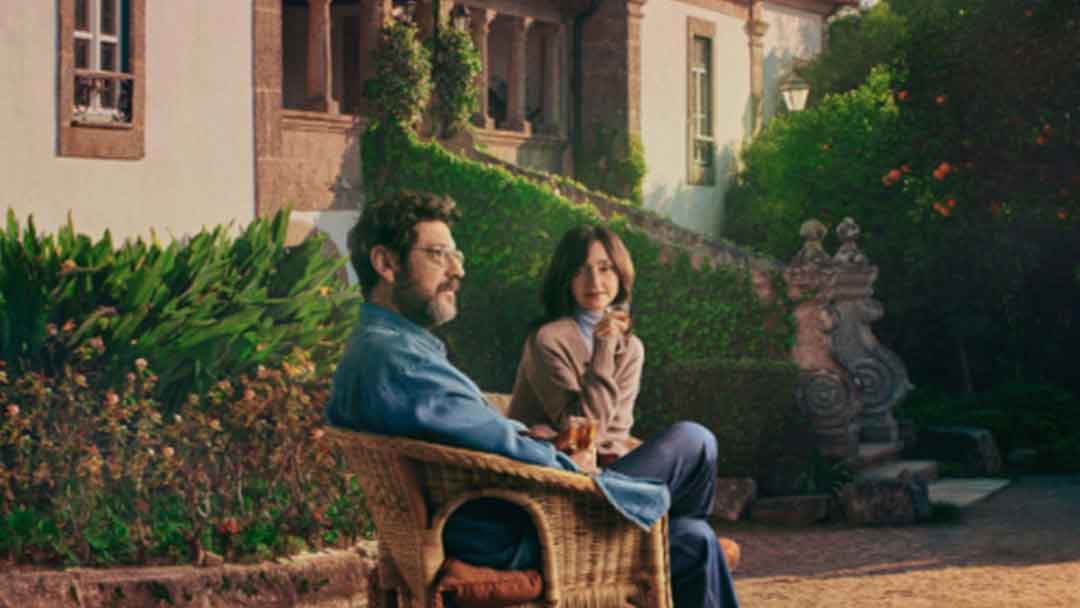
Co-written and directed by Prat, the film begins with Fernando, a geography professor whose wife abruptly leaves him without explanation. Faced with the sort of mid-life existential crisis that usually produces either a road movie or a very expensive therapist, Fernando chooses Portugal. On the journey he encounters Manuel, an itinerant gardener with his own destination. When Manuel unexpectedly dies of a heart attack, Fernando does something that is both morally dubious and narratively irresistible: he takes his identity and carries on to the Portuguese house Manuel was heading for.
From here, The Portuguese House settles into its curious, quietly seductive rhythm. Fernando becomes an accidental intruder in somebody else’s world, and the deception gives him the opportunity to become a slightly different version of himself.
It is classic storytelling in the best sense. There is a house with secrets, strangers arriving from elsewhere, unexplained absences, gardens, long conversations and people whose pasts gradually emerge over dinner or across a table. The film feels as though it might have wandered in from another, slower period of European cinema — somewhere between a literary adaptation and a classic summer drama — and is none the worse for it.
Part of the enjoyment here is its refusal to behave like a contemporary film. Prat trusts silence. She lets people talk. She allows a landscape to exist without somebody having to explain its symbolic significance. And when two characters look at each other, we are allowed to wonder what they are thinking rather than being immediately supplied with the answer.
Manolo Solo is excellent as Fernando, playing him with an appealing mixture of bewilderment, melancholy and dry humour. His performance makes the character’s unlikely transformation surprisingly convincing. He isn’t suddenly reinvented; rather, the shock of being nobody in particular seems to loosen something that had become stuck.
Maria de Medeiros brings an equally attractive ambiguity to the film. Their developing relationship is handled with considerable intelligence. Is it friendship? Romance? Mutual rescue? Perhaps it doesn’t matter. Prat is interested in the intimacy that can grow between people who have no predetermined reason to be in each other’s lives.
There is humour here, too, although it is the kind that slips in rather than announces itself. Fernando’s predicament is faintly absurd — imagine discovering that the best way to escape your own life is to pretend to be a dead man — but the film never mocks its characters. Its affection for human foolishness is one of its charms.
The Portuguese setting helps enormously. The house and its gardens have the slightly enchanted quality of places in classic cinema where people arrive carrying one story and leave with another. The film makes excellent use of the contrast between Fernando’s unsettled state and the physical solidity of this new environment.
Not everything works quite as effortlessly. The film’s leisurely pace and refusal to spell everything out will maybe not appeal so much to audiences accustomed to faster-moving dramas, while some of its narrative turns have the pleasingly improbable quality of a story told rather than a life observed. But that is part of its character. The Portuguese House isn’t trying to be gritty realism. It belongs to a tradition of cinema in which coincidence is allowed to intervene, houses contain mysteries and strangers can still change your life.
So this old European style and gentle optimism feels earned rather than contrived. This is a film about people who have lost something — a marriage, a sense of purpose, a familiar identity — discovering that loss can also create an opening. There are worse things, after all, than getting lost in Portugal.
IN CINEMAS FROM 2 October 2026