
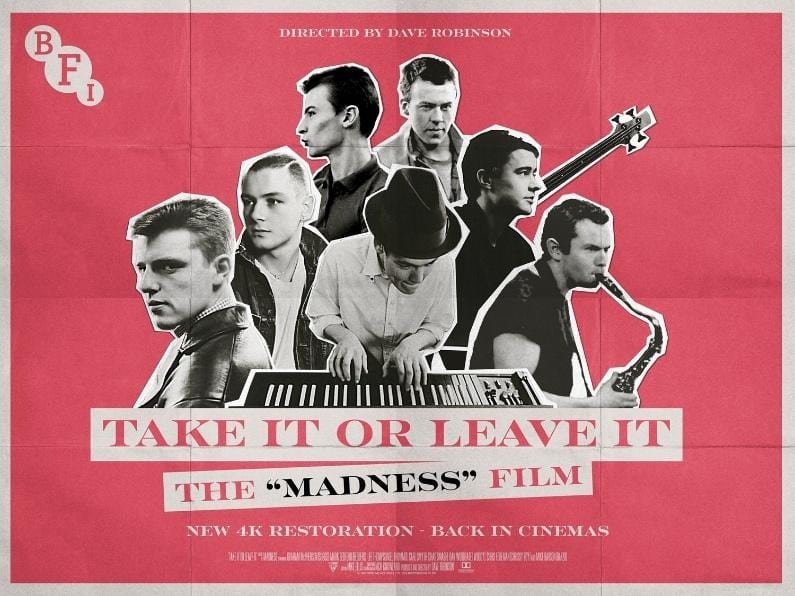

Dir: Dave Robinson. UK, 1981. 87 mins.
There is an appealing contradiction at the heart of Take It or Leave It: a film about the spectacular rise of the English band Madness which is resolutely uninterested in behaving like a rock-star movie.
Released in October 1981, when Madness were already one of Britain’s most recognisable pop groups, Dave Robinson’s first feature looks backwards to the period before the fame, beginning in Camden in 1976 and following the succession of friendships, fallings-out, line-up changes, dead-end jobs and musical experiments that eventually produced the band.
The crucial decision is to make the members of Madness play themselves. Suggs, Mike Barson, Lee Thompson, Chris Foreman, Mark Bedford, Daniel Woodgate and Chas Smash are not asked to impersonate their younger selves through conventional dramatic performance. Instead, they reconstruct episodes from their own past, often with the awkwardness of people remembering something rather than actors performing it. The distinction gives the film its peculiar energy.
It also prevents Take It or Leave It from becoming a conventional rise-and-fall narrative. There is no tortured genius waiting to be discovered, no Svengali figure and no obligatory moment when success destroys the friendship. Robinson’s story is more prosaic and, consequently, more revealing: people form a band because they want to play music, discover that being in a band involves considerably more effort than anticipated, argue about who is doing what, acquire new members and gradually discover that the thing they are doing might actually become a career.
The chronology moves from the North London Invaders of 1976 through the adoption of the Madness name in 1979 and into the extraordinary acceleration of their career. By the time the film was made, One Step Beyond… had established the band’s distinctive ska-pop identity, while singles such as Baggy Trousers, Night Boat to Cairo and Embarrassment had turned their visual eccentricity into a national pop language.
What Robinson does, however, is to make that success feel almost incidental. The film is less interested in the mechanics of becoming famous than in the texture of not being famous: the rehearsals, jobs, girlfriends, pubs, arguments and humiliations. The band are allowed to remain a collection of individuals rather than being retrospectively moulded into a unified pop phenomenon.
That looseness comes directly from the method. Robinson interviewed the members about their favourite memories and built the film from those recollections; there was no conventional completed screenplay, while scenes were largely improvised. Editor Michael Ellis has described the film as something that was substantially discovered in the cutting room. It was shot on two 16mm cameras and subsequently blown up to 35mm.
The visual style consequently has a pleasantly homemade quality. It is not polished enough to conceal the process of reconstruction, and Robinson does not seem particularly concerned that the seams should disappear. Locations connected with the band’s real history are used to give the film a geographical authenticity, while the camera moves between dramatised scenes, performance material and the visual world that Madness had already established in their promotional films.
This is important because Madness were among the first British pop groups for whom the image was inseparable from the music. The loping choreography, exaggerated expressions, suits, hats and physical comedy were not decoration around the songs; they were part of the band’s identity. Robinson, who had already directed Madness videos including One Step Beyond and Baggy Trousers, understands this instinctively.
As a result, Take It or Leave It sometimes feels like an unusually long Madness video that has escaped into feature-film territory. The songs provide punctuation rather than simply functioning as soundtrack material. Musical performance becomes a way of advancing the narrative: the band gradually becomes more assured in front of an audience at precisely the same time that the film’s scale expands.
The performances themselves are deliberately uneven. Some of the band members possess an effortless screen presence; others look as though they would rather be somewhere else. But the lack of professional acting technique has an unexpected advantage. Their relationships feel less scripted because they are not attempting to manufacture conventional dramatic emotion. A pause, a glance or an apparently throwaway exchange can feel more truthful than a carefully written confrontation.
The weakness is that the film occasionally mistakes authenticity for drama. Episodes are presented because they happened, not necessarily because they develop the narrative. Characters appear and disappear according to the memories being reconstructed, and the chronology can feel episodic. The film has the shape of a scrapbook rather than a tightly constructed screenplay.
Yet that may be the most honest way of representing Madness. Their career was not the product of a single grand decision. It accumulated through accident, persistence and personality. The film’s episodic structure reproduces that sense of events happening before anyone fully understands their significance.
There is also something unusually self-aware about the timing. Take It or Leave It was made when Madness were still close enough to their origins to remember them vividly, but successful enough to look back at those origins from another world. The film therefore occupies an intriguing historical moment: the musicians are already pop stars, but the mythology has not yet hardened around them.
Its final movement towards the large-scale live performance makes the point without needing to spell it out. The small North London beginnings have become a mass audience. The transformation is visible rather than explained.
Robinson’s film is therefore most successful when it refuses to turn Madness into heroes. It presents them as opportunists in the best sense: young men sufficiently obsessed with making music to keep going through the periods when there was little reason to believe it would lead anywhere. Their eventual success is extraordinary precisely because the people involved seem, for much of the film, so ordinary.
There are things the film leaves unexplored, and its cheerfulness can sometimes become evasive. But its limitations are inseparable from its peculiar charm. This is not an authoritative history of Madness; it is a memory of Madness made by Madness at the moment when memory was becoming mythology.
More than four decades later, that gives Take It or Leave It its real value. It catches the band before nostalgia has had time to tidy up the past. The film is scruffy, funny, affectionate and occasionally clumsy — but those qualities make it a remarkably vivid record of a particular British pop moment.
Madness would go on to become considerably more than the seven young men reconstructed here. But Robinson’s film understands something that a more polished biopic might have lost: the unlikely part of their story is not that they became famous, but that they kept playing long enough for fame to find them.
TAKE IT OR LEAVE IT is released in cinemas in the UK & Ireland on 2 October 2026, with previews from 30 September, and on BFI Blu-ray/DVD Limited Edition on 19 October