
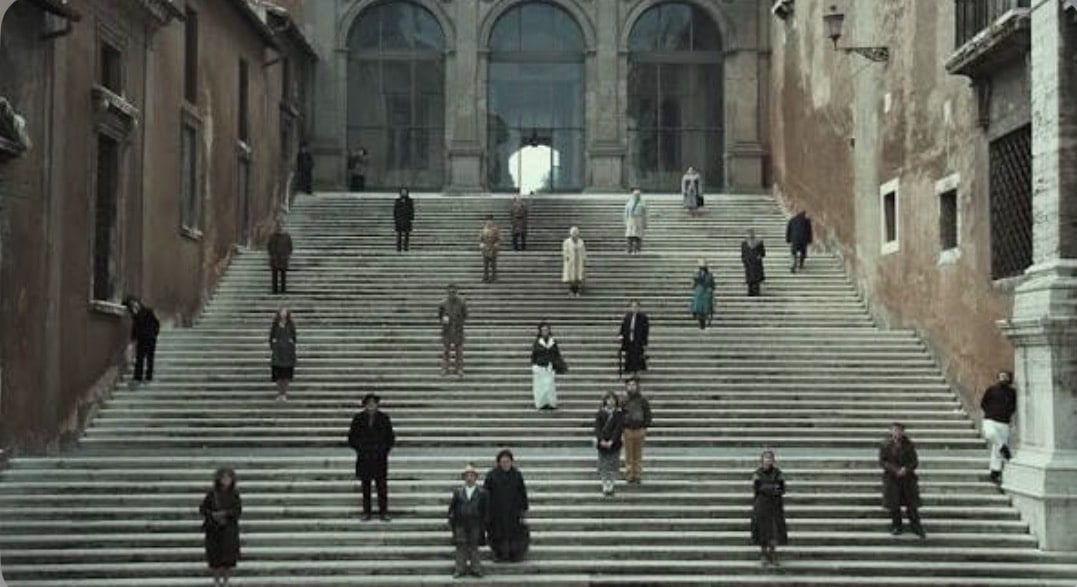

Dir: Andrei Tarkovsky | Drama
Tarkovsky’s Nostalghia is perhaps the most intimate of all his films—not because it reveals more of its maker than Mirror, but because it quietly transforms his own exile into cinema. It is a work in which every image seems suspended between memory and disappearance, where landscapes carry emotional weight and silence becomes a language more eloquent than dialogue. If Andrei Rublev is his epic of artistic faith, Stalker his philosophical pilgrimage, and Mirror his fractured autobiography, Nostalghia is the meditation that follows, the film of a man who has realised that home is no longer a place to which he can return.
Made in Italy in 1983, the film follows Russian writer Andrei Gorchakov as he researches the life of an expatriate composer. Yet the narrative functions less as plot than as emotional terrain. Italy’s luminous churches, mist-covered pools and crumbling villas never become picturesque postcards; under Tarkovsky’s gaze they acquire the melancholy of remembered dreams. The country is beautiful, but beauty itself becomes another reminder of absence. Every frame aches with the distance between where the body resides and where the soul still wanders.
Tarkovsky’s cinema had always been preoccupied with time, memory and spiritual longing, but Nostalghia distils those themes into their purest form. Water drips through abandoned buildings, candles flicker against darkness, rain falls indoors as naturally as outdoors, and every elemental image suggests that the physical world is merely the visible skin of something eternal. His famously patient camera does not simply observe; it waits, inviting us into a different rhythm of existence where contemplation itself becomes dramatic.
The film’s emotional centre lies in the encounter between Gorchakov and the eccentric Domenico, a visionary dismissed as mad yet driven by a desperate belief that humanity has lost its spiritual compass. Their relationship avoids conventional symbolism. Instead, Tarkovsky presents two lonely men searching for redemption in different languages but with the same yearning. The extraordinary candle sequence—drawn out with unwavering conviction—becomes one of cinema’s most profound expressions of perseverance, demonstrating how an act of apparent futility can become an affirmation of faith.
What distinguishes Nostalghia within Tarkovsky’s canon is its sense of irreversible farewell. Although The Sacrifice, his final film, carries an even greater awareness of mortality, Nostalghia marks the moment when exile ceased to be temporary. During and after its production, Tarkovsky’s separation from the Soviet Union became permanent. He would never return to his homeland. The homesickness that gives the film its title is therefore not merely Gorchakov’s condition but the director’s own, expressed not as autobiography but as poetic truth.
Tarkovsky himself regarded Nostalghia with profound personal significance. He described nostalgia not as sentimental remembrance but as a painful spiritual condition—a longing that cannot be cured because what has been lost exists as much in time as in geography. The film emerged from his conviction that modern civilisation had become spiritually impoverished, increasingly detached from the inner life that art should nourish. In Nostalghia, he sought neither political commentary nor psychological realism, but a cinematic prayer for reconnection with memory, faith and human compassion.
Watching the film today, its power remains undiminished precisely because it refuses easy interpretation. It asks viewers not to solve it but to inhabit it. Like the lingering echo of distant church bells or mist settling over an empty field, its meaning unfolds long after the final image has faded. Few directors have trusted the audience so completely; fewer still have created works that reward such trust with such inexhaustible beauty.
Within Tarkovsky’s extraordinary body of work, Nostalghia stands as the quiet heart of his late career: less immediately astonishing than Stalker, less emotionally direct than Mirror, yet perhaps his most complete expression of exile as a spiritual state. It is a film that does not simply depict longing—it becomes longing itself, preserving in every rain-soaked image the fragile hope that memory, faith and art might together illuminate even the loneliest path home.
NOW in CURZON CINEMAS Uk