

Dir: Cody Sheehy | US Doc 83’
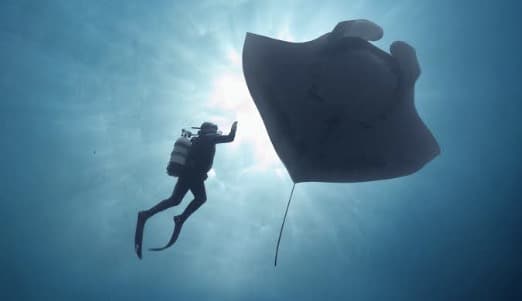
If you enjoy a good nature documentary especially one with a positive outcome then The Last Dive will appeal. Directed by Cody Sheehy, the film follows veteran diver Terry Kennedy on a deeply personal mission: a final journey to reconnect with Willy, a giant manta ray whose extraordinary relationship with him transformed the course of his life.
What begins as an adventure story gradually reveals itself as a meditation on ageing, redemption, friendship, and humanity’s relationship with the natural world.
The film’s greatest strength is its central character. He may not be Richard Attenborough but Terry is far from a conventional environmental hero. A man with a complicated past, he carries the scars of previous lives and choices, making his evolution into a passionate advocate for marine conservation all the more compelling. The documentary never sanitises him; instead, it accepts his contradictions. This honesty gives the story its emotional weight and allows audiences to connect with him as a person rather than a symbol.
Sheehy’s film has a well-developed dramatic arc and the emotional highs are considerable. Moments recalling Terry’s encounters with Willy are filled with wonder, showing how transformative a connection with wildlife can be. There is a real buzz in seeing the man rediscover purpose through an unlikely friendship. The film also captures the exhilaration of exploration, with sequences that evoke the thrill of venturing into an immense and mysterious ocean world and living life immersed in the natural world
Yet the documentary’s most affecting moments emerge from its lows. Terry’s advancing age hangs over the story, creating a sense of urgency and vulnerability. The possibility that some reunions may never happen gives a bittersweet quality. The film confronts loss—not only the potential loss of a beloved animal companion, but also the inevitability of time itself. These quieter passages elevate the documentary beyond environmental advocacy into something universally human.
What ultimately makes The Last Dive resonate is its hopeful message. The film suggests that transformation remains possible at any stage of life. It argues that compassion can emerge from unexpected places and that meaningful connections—whether with people or animals—can reshape our understanding of ourselves. Rather than preaching conservation, it invites empathy, allowing concern for the natural world to arise organically through Terry’s experience.
The human angle is the documentary’s secret weapon. Beneath the marine adventure lies a story about seeking closure, confronting mortality, and searching for purpose. Terry’s journey becomes a reflection of our own desire to reconnect with the things that have given our lives meaning. By the final act, the film feels less like a documentary about a manta ray and more like a portrait of a man trying to make peace with his past and future.
The film’s visual achievement explains why it received major recognition for cinematography. Its underwater photography is consistently breathtaking, capturing manta rays, open-ocean landscapes, and shafts of light with a painterly elegance. The cinematographers, Johnny Friday and Chance Falkner, worked in remote marine environments and transformed the ocean into a cinematic character in its own right. Their images balance scale and intimacy, making viewers feel both the grandeur of nature and the emotional significance of Terry’s quest. The award-winning cinematography never feels ornamental; it serves the story, immersing the audience in the same sense of awe that changed Terry’s life.
The Last Dive succeeds because it understands that the most powerful environmental stories are ultimately human stories. Beautifully photographed, emotionally generous, and quietly profound, it leaves audiences with a renewed appreciation for connection, second chances, and the enduring mystery of the natural world.
SCREENING DURING RAINDANCE FILM FESTIVAL 2026