


Dir: Celyn Jones – UK/Wales, Drama
Reviewed by Peter Herbert
Madfabulous is not nearly as mad nor fabulous as the title suggests. The subject matter is the true-life story of one of queer culture’s most flamboyant and eccentric characters ever to grace the archives of Welsh culture.
Henry Cyril Paget (1875–1905) lived a short life marked by poor health, with few lifestyle restraints or filters. He was the 5th Marquess of Anglesey and lived on the island of Anglesey, where he squandered a vast fortune inherited from his father. There is gossip about why he turned, for example, a church into a music hall. His uncertain sexuality invited speculation that he never had sexual relationships with anyone, including his wife, whom he requested pose naked and sleep adorned only with jewels.
As created by Celyn Jones, Madfabulous is the first Welsh feature film made about Paget, and for this reason the film is more than welcome.
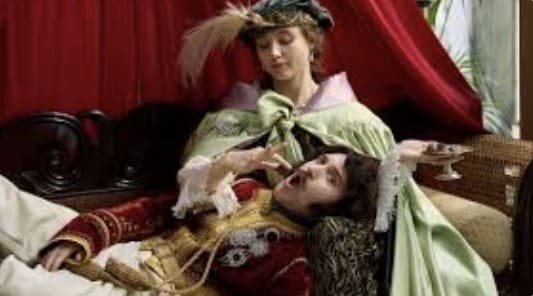
Where the film falls short is in the missed opportunities linked to the Paget estate, which destroyed details considered by the family to be shameful. Despite the absence of verified facts, the film chooses a conventional approach towards a classic case of narcissism. Paget was essentially unlovable, as the only person he could love—and make love to—was himself. There are undeniable truths to explore here regardless of the purged factual detail, and the film does have its moments. These include metaphysical hallucinations involving blood and roses, a bacchanalian orgy, Paget’s naked run through his castle, and a handful of beautiful surrealist images.
The decision to reveal the likely cause of Paget’s dysphoric behaviour halfway through the film serves to constrain it, as this key revelation appears casual, neat, and simplistic. This also generally impacts the central performance of Callum Scott Howells as Paget. The actor provided a sensitive breakthrough performance as an AIDS victim in Russell T Davies’ It’s a Sin and pushed the boundaries of camp extravagance on stage in the West End production of Cabaret. He feels a shade restrained here and only occasionally able to explore the fascinating depths of a troubled queer man.
Rupert Everett’s performance, on the other hand, as Paget’s long-suffering and supportive manservant Gelert, conveys the gravity of a mature artist expressing knowing awareness through quiet expression. He feels like a gentleman who has seen and knows a lot more than he was brought up to reveal, and this adds a thoughtful layer to the film itself.
It is interesting that the likely cause of Paget’s behaviour is linked to a toxic relationship with a father who failed to show love, nor taught his son the lessons of life, including how to navigate the corporate rules of the game. These are all powerful elements that invite the creative imagination.
Curiously, Madfabulous does not go for the Rosebud revelation at the conclusion of Citizen Kane, directed by Orson Welles, which transforms everything we have been listening to and watching. It is intriguing to consider that the true-life central characters of both Welles’s and Jones’s films offer comparable riches with which to explore the troubled origins of wealthy and larger-than-life characters.
Ken Russell could have interrogated this material with his customary extravagant and flamboyant imagination. Madfabulous is closer in spirit to more conventional biopics, including Herbert Ross’s Nijinsky (1980) and Richard Fleischer’s The Incredible Sarah (1976). This is not to say there is no place for relatively safe biopics about widely contentious characters, and Madfabulous sits very well within this genre.
NOW IN UK CINEMAS