
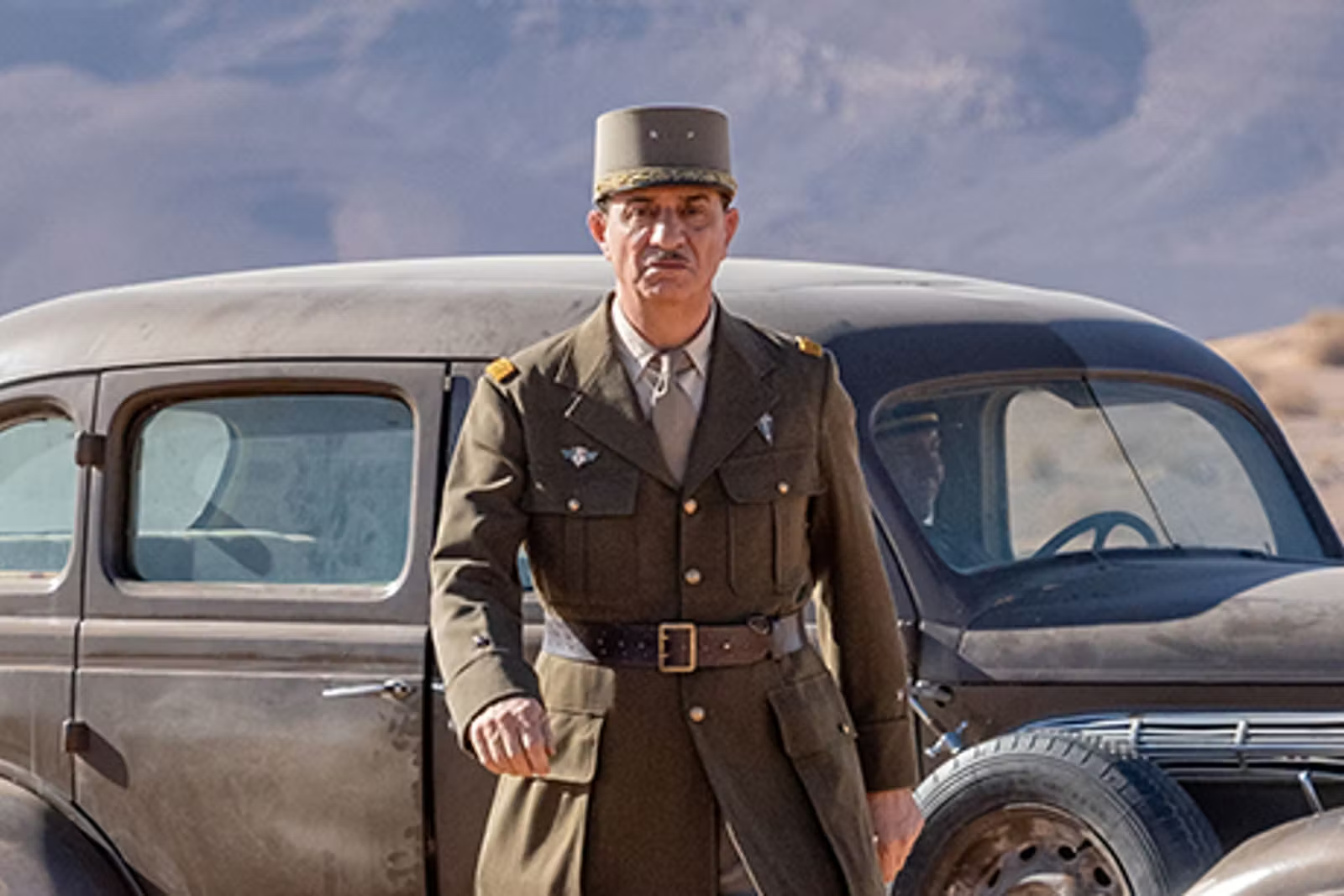

Dir: Antonin Baudry | Cast: Simon Abkarian, Simon Russell Beale, Florian Lesieur | France, Historial Biopic,160′
Antonin Baudry’s La Bataille de Gaulle: L’Âge de Fer is not just an historical biopic; it is an ambitious meditation about leadership, resistance, and the fragile birth of political myth.
Set in the catastrophic summer of 1940, when France collapses under the weight of military defeat and signs the armistice with Nazi Germany, the film follows the obscure General Charles de Gaulle as he makes his way over to London in the hope of persuading the world that France has not surrendered to Germany with the collaboration of Marechal Petain.
The film takes place during one of the darkest moments in modern French history. Following the partition of France by the Nazis, the Vichy regime emerged while de Gaulle, largely unknown to the public, issued his appeal from London and began constructing what would become the Free French movement.
Rather than presenting the Second World War as an inevitable march toward victory, Baudry puts the focus on uncertainty. We all know that de Gaulle will go down in the annuls of history as an iconic figure, but the film continually reminds us that, in 1940, his success appeared highly improbable.
The French subtitle, L’Âge de fer (“The Iron Age”), evokes a world of betrayal, violence, and moral corrosion. France is portrayed not as a nation united in resistance but as a fractured landscape of doubt, accommodation, and scattered acts of courage. In the early 1940s France was almost engaged in a civil war.
Simon Abkarian plays Charles de Gaulle as a stoical man of courage. His de Gaulle is austere, stubborn, and often isolated – yet we feel for him. The soulful performance captures a man driven by conviction rather than charisma, a figure whose certainty borders on obsession. He becomes the rock around which the film’s political storms revolve.
As Winston Churchill Simon Russell Beale brings wit, intelligence, and ambiguity. Churchill is neither patron nor adversary; he is a political realist forced to weigh de Gaulle’s idealism against British strategic interests. Their scenes together crackle with tension, revealing an uneasy alliance built as much on necessity as on mutual respect.
The film’s emotional heart, however, is Fernand (Florian Lesieur). While de Gaulle and Churchill operate on the grand stage of history, Fernand experiences the war as a real teenager of the time. Through his eyes, resistance is not just an abstract political idea; he actually feels it passionately and provides the human scale balancing the film’s geopolitical sides. And this three-strand narrative structure works as a balancing act, Baudry moving fluidly between de Gaulle’s diplomatic struggle in London, Churchill’s wartime calculations, and Fernand’s experience among ordinary French people. Rather than feeling fragmented, these threads gradually come together creating a sense of historical simultaneity, reminding us that great events are always experienced differently from the various viewpoints.
The film repeatedly cuts from the corridors of power, where history is negotiated, to the streets where reality plays out. A speech delivered in London echoes in occupied France; a strategic decision taken by statesmen reverberates in the life of an ordinary teenager.
The structure resembles a historical tapestry. De Gaulle provides the ideological thread, Churchill the political thread, and Fernand the human thread. Together they form a portrait of resistance that is broader and more nuanced than a conventional biography. Pierre Cottereau’s brilliant camerawork, reinforces these thematic contrasts with some astonishing set pieces both on the wide screen and in more intimate sequences.
London with its rainy streets and misty cityscapes is captured in muted tones, emphasising the loneliness of exile and the burden of political responsibility for de Gaulle – who nevertheless gets to live in the swanky house in Hampstead. In contrast, the sequences involving Fernand are charged with the rousing intensity of his experience as a young man desperate to make a difference with the ‘Libre France’ challenging the Vichy regime, and willing to die for his beliefs, along with his two close friends.
So De Gaulle: Tilting Iron is not just a dry historical epic, it takes on board the human story that history is not just about the famous leaders. By intertwining the destinies of de Gaulle, Churchill, and Fernand, Baudry transforms a familiar chapter of World War II into a layered exploration of courage and political imagination as it was actually unfolding.
De Gaulle: Age de Fer (part I of a two-parter) is a film of considerable intellectual ambition and emotional resonance—part war drama, part political thriller, and part coming-of-age story, it’s also really gripping and entertaining – certainly one of the most enjoyable historical biopics so far this year.
NOW IN FRENCH CINEMAS | World Premiere Cannes 2026