
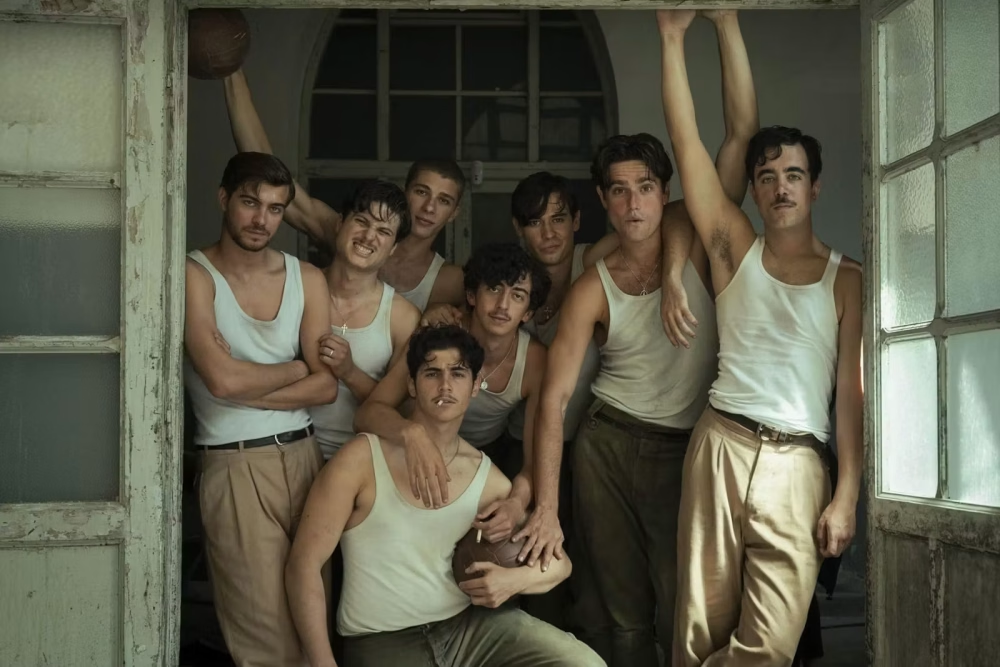

Dirs: Javier Calvo – Javier Ambrossi | Spain Drama 155′
La Bola Negra (Black Ball) is certainly a rambunctious spectacle detonating gay pride in the final days of this year’s Cannes Film Festival. Wrapped in the weight of history, memory and queer reclamation, it takes the form of an ambitious triptych stretching across Spain in 1932, 1937 and 2017.
Haunted by the legacy of Federico García Lorca (Bodas de Sangre) and inspired by fragments of his unfinished work, alongside Alberto Conejero’s La piedra oscura, the film sets out to connect generations of gay men separated by repression, silence and political violence. And boy – have they made up for lost time.
The structure is sprawling but initially compelling, told in past and present in parallel narratives. It follows Sebastián (singer-songwriter Guitarricadelafuente) a young Republican soldier in love with Rafael (Miguel Bernardeau), a figure linked to Lorca’s own emotional history. In the contemporary strand, Alberto (Carlos González) struggles with inherited trauma and a difficult relationship with his mother (Lola Duenas), while Milo Quifes’ Carlos represents a younger generation searching for connection in the shadow of buried histories. This is all jazzed up by vignettes from Penélope Cruz (a scarlet-lipped diva) and Glenn Close, an American novelist, each lending the film a heightened theatricality.
For its first hour, La Bola Negra is genuinely intoxicating. The opening scene is impressive – an Italian air raid accidentally obliterating a small Andalusian village. The imagery is lyrical, often ravishing, with Calvo and Ambrossi embracing a kind of operatic queer melodrama that merges poetry, music and historical memory into something visually magnetic. The film’s shifting timelines echo one another elegantly at first, and the directors’ passion for excavating erased queer histories gives the project emotional urgency. Certain sequences — particularly those involving Cruz — have the grandeur of old Spanish cinema filtered through contemporary queer iconography. And Guitarricadelafuente is certainly an eye-full as the film’s connective tissue. With his gorgeous locks and brooding ‘come-to-bed eyes’, he gives a performance exuding vulnerability and soulfulness although his passionate obsession for lover Rafael is met with nonchalance.
Gradually the film begins to shatter under the scale of its desire to trumpet the message to the world. At 155 minutes, Bola Negra becomes exhausting rather than immersive, the storytelling back-seated by the film’s determination to announce its cultural and political significance. The emotional through-line is repeatedly interrupted by indulgent dream imagery, prolonged symbolic passages and sequences staged less for dramatic necessity than for reverence toward its own queer mythology.
What begins as a moving exploration of repression and inheritance slowly hardens into a monument to itself. The directors are so intent on foregrounding the film’s queer credentials and historical mission that the characters are often reduced to vessels for statements about identity and memory rather than fully realised people. The themes remain powerful — silence, generational trauma, the erasure of gay lives from Spanish history — but they drown beneath layers of spectacle and solemnity.
There is no denying the ambition of La Bola Negra, nor the sincerity behind it, and that’s to be congratulated. Cannes audiences have embraced it passionately, and its visual confidence is undeniable. Yet the film ultimately mistakes magnitude for depth. By the end, what should feel transcendent instead feels over-extended: an undeniably important work that loses sight of the human story beneath the pageantry.
CANNES FILM FESTIVAL | IN COMPETITION