
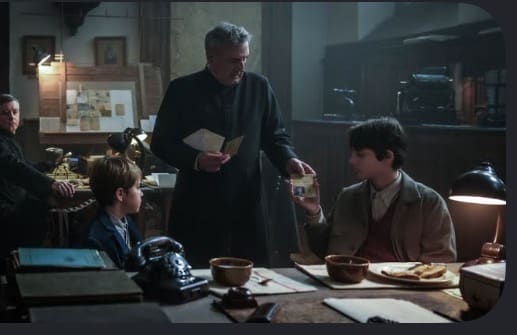


Dir: Daniel Auteuil | Cast: Daniel Auteuil, Grégoire Gadebois, Antoine Reinartz | Biopic France 100′
Daniel Auteuil’s La Troisième Nuit (When the Night Falls) is amongst this year’s most revealing wartime films. Set in August 1942 during the Vichy regime when France was under German occupation, it shines a light on the little-known endeavour to save over 100 Jewish children in the internment camp at Vénissieux, near Lyon, where foreign Jews and other ‘undesirables’ were detained prior to deportation to Nazi Germany, ordered by Marshal Petain.
The film centres on Gilbert Lesage, a civil servant trapped inside the machinery of Vichy bureaucracy, and Father Alexandre Glasberg, played by Auteuil himself, a real-life priest and resistance figure. Together, they attempt to sabotage the deportation system from within.
Auteuil directs with restraint rather than spectacle, Jean-Francois Hensgens conjuring up the disturbing milieu with shadows and penumbral camerawork. There are no soaring speeches or easy emotional crescendos — just red tape, paperwork, and impossible moral choices. That understatement becomes the film’s strength. The horror emerges not through violence but administration: signatures, lists, officials quietly deciding who lives and who disappears into the death camps.
As Glasberg, Auteuil gives one of his most moving performances, playing the priest not as a saintly hero but as a weary strategist, constantly negotiating with collaborators while trying to preserve his own humanity. Antoine Reinartz is a thoughtful and kind-hearted Lesage, embodying the terror of a man waking up too late to the reality of the regime he serves.
The story draws heavily from the real events surrounding the Vénissieux roundup and the bid to save the children, with historian Valérie Portheret serving as historical adviser to the production. Her research into the rescue networks clearly shapes the film’s documentary-like attention to detail. A particularly harrowing scene, that takes place evocatively during a storm-lashed night, pictures parents signing away guardianship of their kids in an effort to save their lives before they themselves are bundled onto buses bound for the German border. Most would never meet again.
If La Troisième Nuit occasionally feels overly austere, its moral clarity lingers long after it ends. In a Cannes lineup full of louder, flashier films, Auteuil delivers something rarer: a sober, haunting reminder of how Nazism operated not only through monsters, but through ordinary civil servants who worked together in silent collaboration.
CANNES FILM FESTIVAL | CANNES PREMIERE