

Dir/Wri: Asghar Farhadi | Drama 139′
Premiering at the Cannes Film Festival, Asghar Faradi’s latest film Parallel Tales is a self-reflexive psychological drama that blurs the boundaries between fiction and reality. Some will find it clever and darkly humorous others deeply pretentious,
It’s been a while since cinema has so explicitly foregrounded sound as both subject and structural device, and Parallel Lives inevitably reminded me of Berberian Sound Studio. Yet where that film found tension in precision and control, this Cannes entry revels in mess—sensory, moral, and narrative.
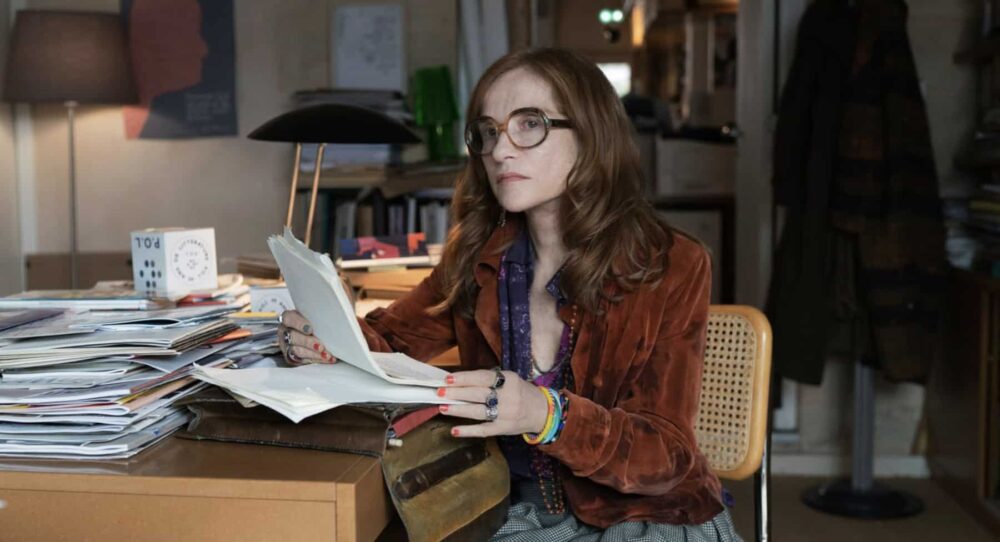
The film centres on Sylvie, a writer, played with cool insouciance by Isabelle Huppert. Sylvie is developing a screenplay about a sound engineer (Vincent Cassel) and his collaborators, including a performer (Virginie Efira) and a foley artist (Pierre Niney). As the narrative unfolds, the writer’s own life begins to mirror—and distort—the story she is creating (with characters appearing both ‘real’ figures and versions of themselves inside her screening) and drawing in a web of voyeurism, cruelty, and sensory obsession. A series of interlocking episodes, including a staged metro robbery and an act of shocking violence, push the film toward an unsettling meditation on perception and manipulation.
From its opening “tricksy” metro robbery, which reveals itself as a kind of performance or scam, the film establishes a world built on artifice. Nothing is quite what it seems, and no character is allowed the comfort of sincerity. This might be the film’s central provocation, but it’s also its greatest limitation: everyone is not just flawed, but actively unpleasant. The characters don’t simply clash—they grind against each other with a kind of deliberate nastiness that begins to feel monotonous rather than incisive.
Huppert, as ever, is compelling playing an awkward character. Her writer is a voyeur in every sense: watching neighbours, mining trauma, and shaping reality into fiction with little regard for consequence. The film’s preoccupation with observation—people listening, watching, recording—extends into its fixation on sensory detail. Sounds dominate, but so do smells, in a way that feels almost perversely insistent. It’s an unusual choice, though not always a rewarding one; the emphasis on the sensory risks becoming gimmicky.
The film’s meta-structure—Huppert writing a story that we simultaneously see enacted—offers potential for clever interplay, but the execution feels cluttered. Cassel’s sound engineer and Efira’s Anna exist as both characters and constructs, while Niney’s foley artist becomes a disturbingly active manipulator, recording intimate moments, and weaponising them. His eventual act of violence is shocking, but also curiously hollow, more an escalation of the film’s cruelty than a meaningful turning point.
There are flashes of dark humour, clearly intended, but they rarely appealed to everyone in the press audience. Repeated motifs—injuries from broken glass, the almost comic persistence of physical discomfort—begin to feel like strained symbols rather than organic details. Even the presence of Catherine Deneuve, in a brief vignette as Huppert’s editor, adds texture without quite integrating into the whole; the chain-smoking exchanges hint at a richer film about creative complicity that never fully emerges.
Ultimately, Parallel Lives is an intellectual exercise that wants to unsettle through sensory overload and moral bleakness, but its relentless unpleasantness dulls its edge. Its ideas—about authorship, exploitation, and the porous boundary between art and life—are intriguing, yet the film seems more interested in demonstrating them than interrogating them. What lingers is not so much insight as irritation: a sense of having been immersed in something deliberately abrasive, but not especially illuminating.
CANNES FILM FESTIVAL 2026 | IN COMPETITION 2026