
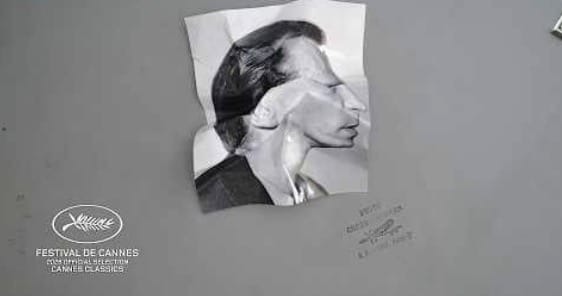


Wir/Dir: Brecht Debackere | Doc 75′ 2026
There’s a certain audacity in calling a film Nostalgia for the Future and premiering it at the Cannes Film Festival 2026—a place that thrives on both reverence and reinvention. Packing plenty of punch into its short running time this new documentary, from Brecht Debackere, arrives soaked in intellectual ambition, invoking the spectral presence of Chris Marker, but ultimately struggles under the weight of that legacy.
Marker (1921-2012) for the uninitiated, wasn’t just a filmmaker; he was a cinematic philosopher born as Chrstian-Francois Bouche Villeneuve: Well that says it all. Best known for La Jetée—a haunting, photo-roman meditation on memory, time, and apocalypse—he reshaped what cinema could be. His work blurred documentary and fiction, essay and narrative, always circling the fragile relationship between past and future. His influence runs deep, particularly in films that dare to treat time as something elastic, subjective, and political.
Nostalgia for the Future clearly wants to situate itself in that lineage. It borrows Marker’s preoccupations—archival imagery, fragmented voiceover, elliptical structure—but too often mistakes aesthetic mimicry for intellectual depth. Where Marker’s films feel like discoveries unfolding in real time, this one feels pre-assembled, its ideas hermetically sealed rather than alive.
At the centre of it all is Charlotte Rampling, whose partrician presence alone lends the film a kind of gravitas it hasn’t quite earned. She plays a semi-fictional archivist—part witness, part oracle—tasked with narrating a world that seems to exist both before and after collapse. Rampling, as ever, is magnetic in stillness. Her voice, cool and measured, does much of the film’s emotional heavy lifting. In quieter moments, she almost convinces you the film has something profound to say.
But even she can’t fully bridge the gap between concept and execution. The script hands her abstractions where it should offer insight, and the film’s pacing—deliberately languid—slides too often into inertia. What should feel hypnotic instead feels stalled.
Visually, there are flashes of brilliance: degraded footage flickering against pristine digital images, time folding in on itself, past and future collapsing into a single, uneasy present. These moments hint at the film it might have been—a genuinely probing meditation on memory in the age of digital overload. But they’re fleeting.
The Cannes audience response is respectful but muted—polite applause rather than fervent debate. And that feels right. Nostalgia for the Future is clearly made with intelligence and intent, but it never quite justifies its invocation of Marker’s towering legacy. Instead of extending his ideas, it circles them cautiously, never quite daring to leap.
In a festival that rewards boldness, this is a film that feels curiously hesitant—caught, like its title suggests, between looking back and moving forward, and never fully committing to either.
CANNES FILM FESTIVAL 2026