

Dir: Damiano Michieletto | Italy 110′
There’s a vague touch of Pygmalion to the idea of this earnest, classically styled Italian costume drama, although the film takes itself far more seriously than Anthony Asquith’s upbeat 1938 romantic comedy. Primavera takes its inspiration from Tiziano Scarpa’s novel “Stabat Mater”, a young woman’s self-realisation under the tutelage of the famous composer Antonio Vivaldi (1678-1741).
Co-written and directed by Damiano Michieletto, best known for his big screen production of operas such as Gianni Schicchi (2021) and Rigoletto al Circo Massimo (2021), Primavera, not surprisingly, veers away from conventional narrative territory with its stagey feel of screened opera. That’s both its strength and its limitation.
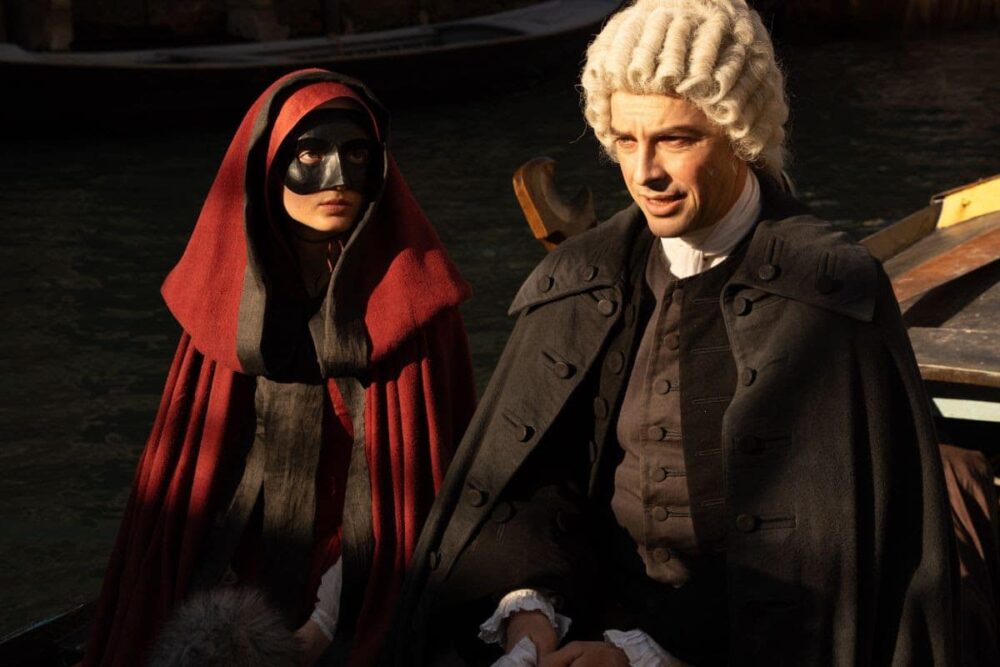
Michieletto approaches the screen the way he approaches the palcoscenico: with a strong emphasis on visual composition, symbolic gesture, and emotional atmosphere rather than tightly structured storytelling. Primavera unfolds in a series of striking tableau-like sequences where characters often seem suspended between realism and allegory. This gives the film a dreamlike quality, but also creates a sense of distance—and the turgid pacing often feels frustrating, robbing the film of much needed dramatic heft.
Vivaldi is best known for his Four Seasons, echoed in the film’s title – ‘Spring’ being the first part of the iconic work, and this is very much felt in the rhythm and tentative pacing that sees young Cecilia, who has grown up in an orphanage in Venice and is now well into her teens, meeting Vivaldi and becoming one of his pupils, and more. An avid violin player, she puts all her angst and passion into the instrument that quivers energetically in response; it is not only a tool to make music but one that will provide the key to her destiny.
Sadly Michieletto’s characters lack depth and are rather reduced to cyphers under the weight of his overbearing visual aesthetic. So they remain mannered, there to serve narrative rather than being fully realised as individuals, and this adds to the film’s overall sense of distance. The lack of intimacy is particularly felt in the relationship between Vivaldi and Cecilia.
Rather like an old master hanging in a gallery, Michieletto has created a mood piece: subdued, quiet and contemplative, with its nuanced moments of silence and delicate lighting, veering between opera and cinema, atmosphere and symbolism triumphing over narrative clarity. Whether it will appeal to opera lovers remains to be seen.
NOW IN UK CINEMAS