
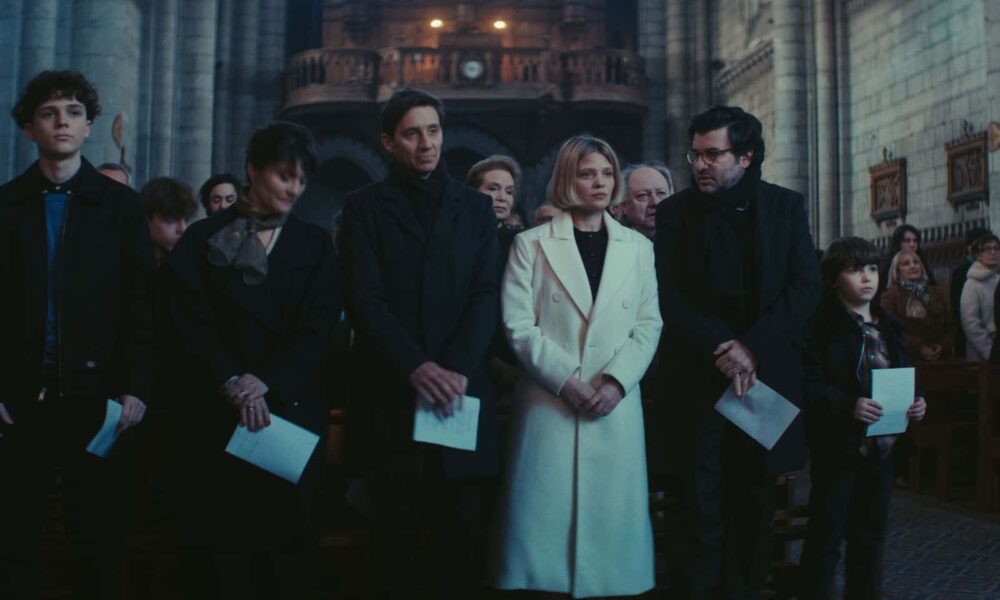

Dir: David Roux | France, Drama 93′
La Femme de, based on Hélène Lenoir’s enigmatically titled novel ‘Son nom d’avant’, is a grim affair that follows David Roux’s first feature The Order of Physicians (2019). There’s nothing particularly engaging about this noir drama with its joyless characters, dreary setting and cliched plotline that culminates in a low-key resolution. That all said, La Femme de is solid and well-acted in the classic style of a small-town thriller by Claude Chabrol and that makes it quietly compelling as a study of unfulfilled womanhood.
In the film’s opening scene – offering the clue to what happens later – Marianne, the main character, is seen being accosted in the street and taking refuge on a bus where a stranger stares intently as she dissolves into tears.
Years later Marianne, now 40, is unhappily married to Eric Caravaca’s sullen and preoccupied industrialist Antoine, who has apparently gone off his wife for not having given him a male heir until much later in the marriage, causing an frigid rift between the two (we see him rebuffing her advances). Marianne continues to play the diminished housewife, essential to the proper functioning of the family unit but disregarded by all and sundry, even her young son Tim. Despite all this she will go on fulfilling her social and marital obligations complicit in her own fall from grace.
David Roux and his co-script writer Gaëlle Macé establish the bourgeois French milieu in the family’s stone mansion near Angers, and this is reinforced by Aurelien Marra’s penumbrous visuals and a dull score. A perpetual grey mist seems to shroud the family in a morose atmosphere of tight-lipped bitterness, where none has any saving grace; Marianne herself is unlikable, and we feel no sympathy for her plight as she plods indolently around the home with a sullen expression. Chabrol again comes to mind here but at least his female characters (Isabelle Huppert, Stephane Audran) had a spark of flirty femininity, Marianne (an unremarkable Mélanie Thierry) is not even given the benefit of being chic having retreated into her dumpy and unfashionable look, one that certainly reflects her character’s depressed and dejected state.
Antoine’s mother has just died and he suggests taking over the family house – spacious and elegantly furnished, it just needs better lighting and a lick of paint. Only problem is his father, a curmudgeonly wheelchair-bound bore, is now part of the furniture and Marianne is forced to minister to him. At the will reading Lili, Antoine’s solicitor sister, complains about not being included in decision-making, and is promptly asked to leave by her authoritarian brother who has now taken charge of all the boring probate arrangements. Clearly it’s a paternalistic set-up and, rather like Madame Bovary her 19th century counterpart, Marianne has no financial independence so her only option is to leave empty-handed, or so it would seem. Even her little son Tim seems to have taken sides with the men in the family – one of whom, Antoine’s younger brother Bob (Arnaud Valois) is a cynical loser who has offered Marianne some solace, but is only there to serve the narrative as an unappealing cypher who hangs around the house aimlessly.
Then the character from the past (Jeremie Rennier) appears, to take photos of the house for a valuation, and he seems to provide the missing clue in the rather enigmatic second half of the film. We instantly remember him as the man on the bus, but what happened between him and Marianne is a mystery that will slowly emerges in the film’s final rather insipid finale.
NOW IN FRENCH CINEMAS