

Dir/Wri: Lav Diaz | Drama | 158’
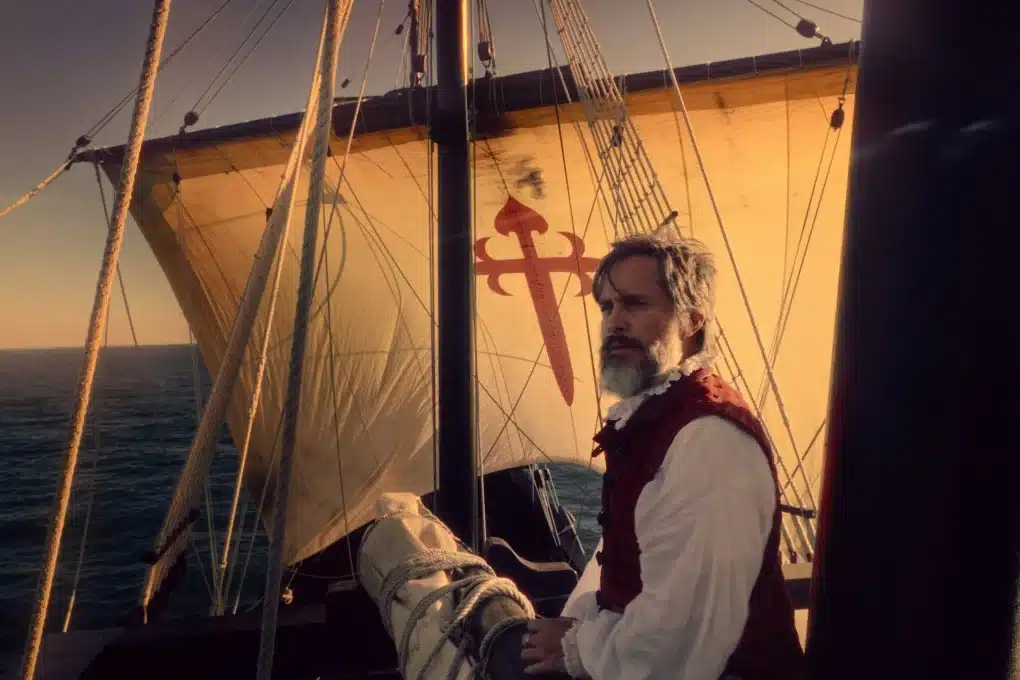
Filipino auteur Lav Diaz turns his attention to one of the great voyages of the Age of Exploration, revisiting the life of Ferdinand Magellan in a visually mesmerising but quietly unsettling account of ambition, discovery and colonial conquest. Shot in the classical 4:3 aspect ratio, the film has the painterly composition and contemplative rhythms of an old master, transporting us to the turbulent world of the early 16th century.
Born in Portugal around 1480, Magellan became convinced that the Spice Islands could be reached by sailing west, opening up a lucrative new trade route for the Spanish Crown. In 1519, he embarked with a fleet of five ships on an extraordinary expedition across the Atlantic and into the uncharted waters of the Pacific. Although Magellan himself would never complete the journey, killed in the Philippines in 1521, one of his ships eventually returned to Spain under Juan Sebastián Elcano, completing the first circumnavigation of the globe. The passage connecting the Atlantic and Pacific that Magellan navigated at the southern tip of South America would subsequently bear his name.
Yet Diaz is less interested in celebrating the conventional mythology of the intrepid European explorer than in exposing the darker realities beneath it. His Magellan, played with disarming composure by Mexican actor Gael García Bernal, is an apparently personable and devout pioneer whose quest for geographical discovery is inseparable from religious zeal, imperial ambition and a conviction of European superiority. What is presented as enlightenment and exploration becomes, from the perspective of those encountered along the way, a brutal exercise in domination, conversion and subjugation.
The film’s moral perspective shifts decisively when Magellan reaches the Philippines, where his attempts to impose Christianity and Spanish authority bring him into conflict with local rulers, most notably the warrior chief Lapulapu. The expedition’s supposed civilising mission meets resistance from a society with its own established cultures, loyalties and systems of power. Magellan’s death at the Battle of Mactan becomes a potent reminder that the history of exploration looks very different depending on whose side of the encounter is being told.
Diaz allows this epic confrontation to unfold at his characteristically unhurried pace, finding drama in observation, silence and the weight of history rather than conventional adventure-movie spectacle. Every frame, photographed and edited by his regular collaborator Artur Tort, has the luminous depth and carefully balanced composition of a Renaissance painting, while the widescreen spectacle traditionally associated with historical epics is replaced by the intimacy and restraint of the 4:3 image.
The result is a fascinating revisionist portrait of a celebrated historical figure, challenging the familiar European narrative of discovery by giving greater weight to the people and places that paid its price. A richly atmospheric example of slow cinema, this is a film to savour rather than rush through — preferably in a comfortable chair, with a nice glass of Olazabal Monte Meão within reach.
In UK CINEMAS .