
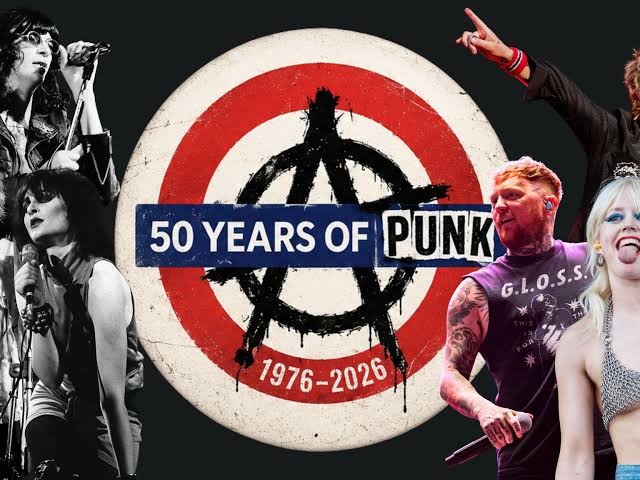

Dir: Mark Sloper | UK Doc 2026
50 Years of Punk arrives at an awkward moment for a movement that was founded on the rejection of anniversaries, nostalgia and respectable history. Fifty years on, however, punk has become part of the cultural establishment it once set out to antagonise. Sloper’s lively documentary recognises that contradiction while returning to the people, places, music and images that made punk such an extraordinary eruption of creativity in Britain in the mid-1970s.
Rather than presenting punk as the invention of a single band, Sloper traces a much wider network of influences and personalities. The New York scene, including the Ramones, the New York Dolls and Iggy Pop, provides part of the background, while in London the King’s Road and Malcolm McLaren and Vivienne Westwood’s increasingly provocative clothing became central to the emerging movement. The Sex Pistols inevitably occupy a prominent place, but they share the film with The Clash, The Damned, The Stranglers, The Slits, Generation X, The Adverts, The Skids and Public Image Ltd. The result is a useful reminder that what subsequently became known as ‘punk’ was never a single musical style.
Sloper has assembled an impressive collection of participants, among them Hugh Cornwell, Dave Vanian, Rat Scabies, Gaye Advert, Richard Jobson, Glen Matlock, Jah Wobble, Terry Chimes, Tony James and Viv Albertine. Their recollections give the film much of its character. There is humour as well as bitterness, and the inevitable disagreements over who did what and when. That is appropriate: punk was a culture of competing personalities and strong opinions, and a documentary in which everyone agreed would hardly feel authentic.
The archive is particularly important. Sloper combines contemporary interviews with photographs, television appearances, performance footage and the rougher, often grainy images of the period. The contrast between today’s measured recollections and the raw immediacy of the 1970s material is striking. The old footage has an energy that no recreation could reproduce. Faces, clothes, clubs, streets and stages appear almost to vibrate with the uncertainty of the time.
The visual style reflects the subject without becoming an imitation of it. Rather than giving us a slick, conventional music documentary, Sloper builds the film out of fragments: still photographs, live footage, fashion imagery, television material and rapidly changing archive sequences. There is a deliberately homemade, cut-and-paste quality to the presentation which recalls the aesthetic of punk posters, fanzines and record sleeves. It works because punk itself was partly a visual revolt. Vivienne Westwood’s clothes, the confrontational graphics, torn fabrics, provocative slogans and deliberately shocking imagery were not decoration around the music; they were part of the statement.
The film is also good at conveying the peculiar social circumstances from which punk emerged. Britain in the 1970s offered young people plenty of reasons to feel alienated, but Sloper does not overburden the story with political explanation. Punk’s response to unemployment, class divisions and a sense of cultural stagnation was not a carefully constructed ideology. It was an attitude: do it yourself, make a noise, make an image, form a band, start a fanzine, challenge somebody’s assumptions. The absence of technical polish could itself become a source of freedom.
There is inevitably a certain melancholy in watching the survivors of a movement that once seemed so threatening now looking back half a century later. The irony is unavoidable. Punk’s great achievement was to demonstrate that outsiders could create their own culture; its subsequent success meant that the culture itself could be packaged, sold and displayed as heritage.
Yet 50 Years of Punk is more than an exercise in remembering the good old days. Its most persuasive argument is that the important legacy of punk was not a particular hairstyle, item of clothing or three-chord guitar riff. It was the permission it gave people to make their own culture. That idea has outlived the original bands and fashions.
Sloper’s documentary does not pretend that punk remained permanently dangerous or revolutionary. Instead, it captures the extraordinary moment before its mythology hardened: when the bands were still unknown, the clothes genuinely shocking and nobody knew whether this strange collection of musicians, artists, designers and misfits would change anything. Fifty years later, the answer is clear. Punk changed rather more than its participants could possibly have imagined.
IN UK CINEMAS FROM 18 September 2026