
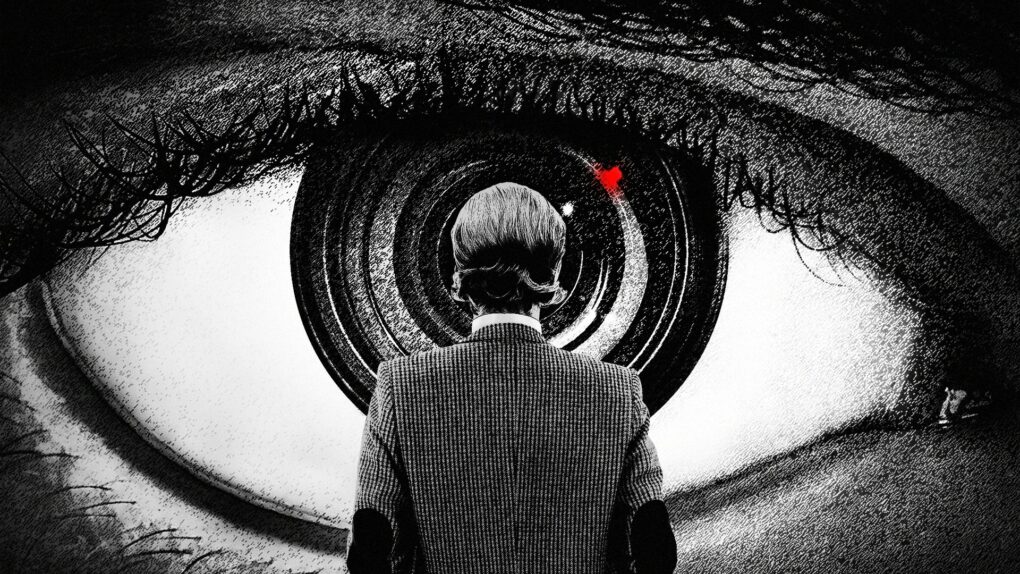

Wri/Dir: Raoul Peck | Doc with Damian Lewis 119′
Reviewed by Ian Long
The human lung contains millions of alveoli. These tiny, delicate structures are a crucial junction between our bodies and the outside world, because it’s here that oxygen is absorbed into the blood from the air. If the alveoli can’t work properly, our bodies go into long-term decline, resulting in fatigue, cognitive impairment, and heart failure.
And it’s in the alveoli that the bacteria which cause tuberculosis settle, making it increasingly difficult – and, finally, impossible – to breathe.
2 + 2 = 5, Raoul Peck’s documentary on George Orwell, is bookended by shots of alveoli (which look like flowing strands of grey, sausagey seaweed), suggesting the fatal embrace in which the writer was gripped by the disease. In 1946, when the film begins, he’s taking advantage of a brief remission to move to the Scottish island of Jura.
We hear Orwell reviewing his life from this vantage point via letters to ‘Freddie’ Warburg (his friend and publisher), and other published and unpublished works, all voiced by Damian Lewis in a clear, unobtrusive way which acknowledges that Orwell’s ideas are strong enough to require no over-emphasis.
Orwell’s anti-authoritarianism seems to have been innate, but his career as a military policeman in Burma greatly reinforced it. Here he witnessed the British colonial beast in its death throes, and his appalled recognition of his own complicity instilled an unsparing vigilance which, for the remainder of his life, he applied to himself, wider society, and the world in general.
2 + 2 = 5 highlights two of Orwell’s books: Animal Farm and most of all, 1984, his last work and the culmination of his ideas. The film details how its writing turned ever more gruelling as his health deteriorated and the mere act of typing became a near-impossible, energy-sapping chore.
Peck uses the montage documentary style pioneered by Julien Temple in films like London: The Modern Babylon (2012). In other words, 2 + 2 = 5 is a non-stop, torrential tapestry of photographs, newsreel, verité footage, drawings by Ralph Steadman, clips from films by directors like Terry Gilliam, David Lean and Carl Dreyer, and numerous excerpts from dramatisations of Orwell’s works.
Peck often intercuts versions of scenes from 1984 or Animal Farm from several different productions, creating a curiously discombobulating, almost psychedelic effect. By the time a few Julia/Winston combinations had repeated “we are the dead” I expected the Bowie song to loom out of the soundtrack, but Diamond Dogs is one artefact infused by late Orwell which Peck doesn’t reference.
Orwell called his background ‘lower upper-middle class’: a subsection of society which shared the tastes and manners of the gentry, but lacked the means to put them into practice. The lure of ‘the provinces’ for this not-quite-elite was obvious: here, they could finally indulge their aristocratic pretensions – hunting, riding, owning opulent houses, and keeping numerous servants.
Peck is clearly fascinated by Orwell as a subject, but his deeper interest lies in demonstrating how the insights of 1984 inform the present. Orwell would be unsurprised by the boilerplate Newspeak euphemisms currently served up by governments and armies – ‘special military operation,’ ‘pacification,’ ‘enhanced interrogation technique,’ ‘alternative fact,’ etc.
Equally, he would see through the contemporary ‘Progressive’ movement’s reframing of reality, its inversion of language and enforcement of belief in (or, at least, acquiescence to) palpable absurdities, although Peck is more concerned with colonial crimes than the mangled ideas flowing out of American academia, so his film doesn’t pursue this.
Even Orwell, though, would be gobsmacked by the myriad ways Big Brother has developed not just to watch us, but to form our day-to-day reality. 2 + 2 = 5 usefully catalogues social media, A.I., deepfakes, billionaire CEOs, and the entire techno-feudalist, corporate surveillance state which has accreted around us all so rapidly that it’s hard to remember when it didn’t exist. It’s the medium we swim in.
As I watched, I noted down some names which I felt merited further research – Danny Schechter, Shoshana Zuboff, Zeynep Tufekci, Eylon Etshtein – and it’s lucky I did, because their comments were so brief and were replaced so quickly by new nuggets of information that I’d forgotten just what they said a day or so after seeing the film.
The point of this is that 2 + 2 = 5 is a very dense work. At two hours, it’s a much bigger undertaking than Peck’s James Baldwin film I Am Not Your Negro, and it contains many big ideas, presented in a highly compressed way. This, and its multilayered nature, means the viewer must work hard, and you’ll need more than one watch to get to grips with it.
IN UK CINEMAS from 27 March 2026 | Reviewed by Ian Long